


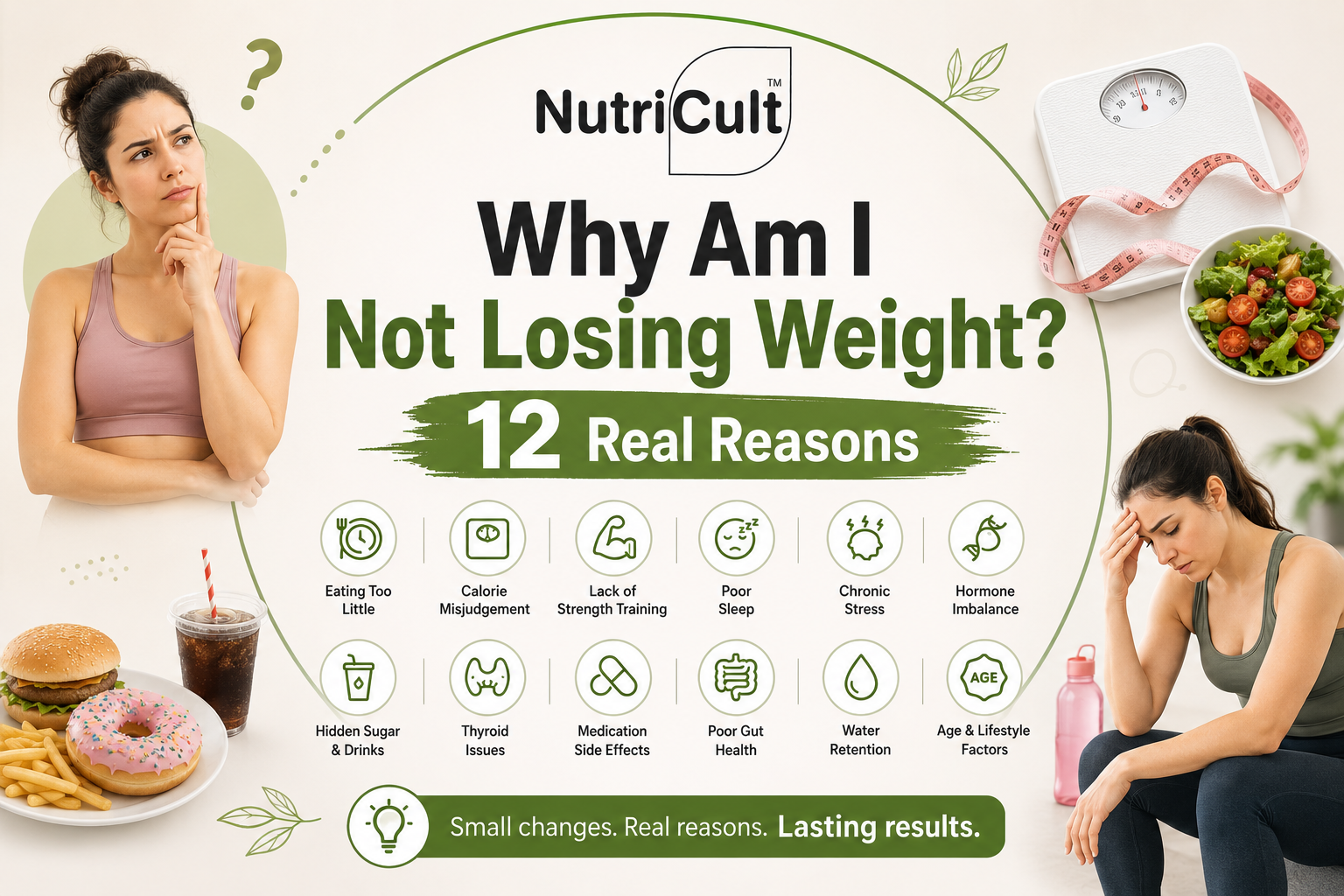
You have cut your portions. You are showing up for your workouts. You have swapped white rice for brown, cut the evening samosas, and you are still staring at the same number on the scale week after week. If you have typed “why am I not losing weight when I exercise and diet” into Google at 11 pm, you are not alone, and you are not broken. There is almost always a specific, fixable reason behind a stalled scale.
Quick Answer
Most people who are not losing weight despite eating well and exercising are dealing with one or more of these: underestimated calorie intake, too little protein or fibre, poor sleep, chronic stress and high cortisol, an undiagnosed thyroid or hormonal issue, water retention masking fat loss, or a plateau caused by the body adapting to a lower weight. The Centers for Disease Control and Prevention (CDC) notes that healthy, sustainable weight loss happens at roughly 0.5 to 1 kg per week, so if you are eating at a genuine deficit and giving it four to six weeks, slow does not mean stuck. Track your food for a week, get seven to nine hours of sleep, and if nothing shifts after two months, ask your doctor to check your thyroid and blood sugar.
Why Is It So Hard for Me to Lose Weight? The Honest Answer
Weight loss looks simple on paper: burn more calories than you eat. In practice, your body is not a calculator. It is a hormonal system that reacts to sleep, stress, food quality, and even how consistently you eat, not just how much. That is why two people on the same diet can lose weight at completely different speeds. Below are the reasons that come up most often when diet and exercise alone are not working.
1. You’re Eating More Than You Think
Hidden calories derail more diets than anything else on this list. Cooking oil, chutneys, nuts, fruit juice, and “healthy” snacks like granola bars are calorie-dense and easy to underestimate. Research on self-reported food intake has repeatedly found that people underestimate what they eat by a wide margin, sometimes by several hundred calories a day, without realising it. A kitchen scale and a food-tracking app for even seven days usually reveals the gap.
What helps: Weigh your food for a week instead of eyeballing it. Our best foods for gut health guide has practical swaps that keep meals filling without the hidden calorie load.
2. You’re Overestimating Calories Burned Through Exercise
Fitness trackers and gym machines routinely overestimate the calories a workout burns, sometimes significantly. Combine that with the common habit of “rewarding” a workout with an extra snack, and the exercise session can end up calorie-neutral or worse. Exercise is essential for long-term health and for keeping muscle while you lose fat, but on its own it is a weaker lever for weight loss than what is on your plate.
3. You’re Not Getting Enough Sleep
Sleep is where a lot of stalled weight loss quietly gets decided. Short sleep raises ghrelin, the hormone that signals hunger, and lowers leptin, the hormone that signals fullness. The result is stronger cravings, especially for high-calorie foods, and less impulse control around them. Most adults need seven to nine hours of quality sleep a night for these hormones to regulate properly. If you are cutting sleep to fit in an early workout, you may be undoing more than you gain.
4. Chronic Stress Is Keeping Cortisol High
Ongoing stress keeps cortisol elevated, and cortisol encourages the body to hold onto fat, particularly around the abdomen. It also drives cravings for calorie-dense comfort food and can push people toward emotional eating. This is not an excuse; it is physiology. Managing stress through walks, breathing exercises, or simply protecting your sleep is a legitimate part of a weight loss plan, not a wellness add-on.
5. Low Protein and Fibre Intake
Protein and fibre are the two nutrients that keep you full longest, and Indian diets often fall short on both. A household-level study across nine districts in six Indian states found that roughly 80% of households consumed less protein than recommended. Without enough protein, hunger climbs faster after meals, and without fibre, blood sugar spikes and dips more sharply, both of which make sticking to a calorie deficit harder than it needs to be. The ICMR-NIN 2024 Dietary Guidelines for Indians recommend building meals around pulses, legumes, dairy, lean meat, fish, or eggs alongside at least four to five servings of vegetables and fruit a day.
What helps: A protein and fibre-forward breakfast keeps appetite steadier through the day. If your gut is sluggish or bloated, that alone can make you feel heavier and less motivated to stay consistent; our Probiotics vs Prebiotics piece explains how gut balance affects digestion and comfort, and the LeanGut Sticks from our Weight Management range are formulated to support that.
6. Liquid Calories You’re Not Counting
Fruit juice, sweetened tea and coffee, flavoured yoghurt drinks, and soft drinks add up quickly because liquid calories do not trigger fullness the way solid food does. It is easy to cut 300 calories from a meal and undo it with two cups of sweet chai and a glass of juice across the day.
7. You’ve Hit a Genuine Weight Loss Plateau
As you lose weight, your body needs fewer calories to function, both because you weigh less and because resting metabolism adapts downward slightly. Weight loss research documents this shift consistently; it does not mean something is wrong with you. A plateau after losing 5 to 10% of your starting weight is common and usually means your calorie needs have changed, not that your effort has stopped working.
8. Doing the Same Workout Every Time
Repeating the exact same cardio routine at the exact same intensity for months leads to metabolic adaptation. Your body becomes more efficient at that specific movement and burns fewer calories doing it over time. Mixing in resistance training helps because building and maintaining muscle keeps your resting metabolism higher than cardio alone.
9. An Undiagnosed Thyroid or Hormonal Issue
Conditions like hypothyroidism, PCOS, insulin resistance, and obstructive sleep apnea can make weight loss genuinely harder, regardless of how consistent your diet and exercise are. Insulin resistance in particular is easy to miss because it does not always show up as full-blown diabetes. The CDC’s National Diabetes Statistics Report estimates that over 115 million American adults currently have prediabetes, and most do not know it; India’s numbers are also rising sharply with urbanisation and shifting diets. If you are doing everything right and still not moving the needle after two to three months, a basic thyroid panel and fasting blood sugar test are worth asking your doctor for.
10. Age-Related Muscle and Hormone Changes
Metabolism naturally slows somewhat after 30, and again around perimenopause or andropause, partly because muscle mass tends to decline with age if it is not actively maintained. Strength training two to three times a week helps preserve the muscle that keeps your metabolism from sliding further.
11. Alcohol More Often Than You Realise
Alcohol is calorie-dense, gets prioritised by the liver over fat burning while it is being metabolised, and tends to lower inhibitions around food choices later in the evening. Even moderate, regular drinking can quietly stall weight loss progress that looks solid everywhere else.
12. Inconsistency, Not Lack of Willpower
Eating well on weekdays and loosening up completely on weekends, or restarting a diet every few weeks after falling off it, tends to average out to maintenance rather than a deficit. Consistency across the full week matters more than any single “perfect” day.
Quick Comparison: Common Culprits and What Actually Helps
|
Reason |
Why It Stalls Weight Loss |
What Helps |
|
Underestimated calorie intake |
Hidden calories from oil, snacks, and condiments add up fast |
Track food for 7 days with a kitchen scale |
|
Poor sleep (under 7 hours) |
Raises ghrelin, lowers leptin, increases cravings |
Prioritise 7 to 9 hours nightly |
|
Chronic stress |
Elevated cortisol promotes fat storage and cravings |
Daily walks, breathing exercises, protected sleep |
|
Low protein and fibre |
Faster hunger return, more blood sugar swings |
Add pulses, dairy, eggs, and vegetables to every meal |
|
Liquid calories |
Do not trigger fullness like solid food |
Swap juice and sweet chai for water or unsweetened tea |
|
Repetitive workouts |
Body adapts, burns fewer calories over time |
Rotate cardio with resistance training |
|
Undiagnosed thyroid/insulin issues |
Hormonal signals override calorie deficit |
Ask your doctor for a thyroid panel and blood sugar test |
|
Weekend inconsistency |
Averages out weekly deficit to maintenance |
Aim for steady habits across all 7 days |
A Brief Note on Caution and Side Effects
Very low-calorie diets, skipping meals to “make up” for a binge, or exercising for hours daily to force a faster result can backfire. They tend to cause excess muscle loss, nutrient deficiencies, fatigue, hair thinning, irregular periods in women, and a slower metabolism that makes long-term maintenance harder, not easier. If you notice persistent fatigue, hair fall, mood changes, irregular cycles, or you are losing weight despite eating very little, these are reasons to see a doctor rather than push harder. Weight loss supplements and gut-support products, including probiotics and apple cider vinegar, are meant to complement a balanced diet and should not replace medical care for suspected hormonal conditions.
FAQ
Why am I not losing weight when I exercise and diet?
The most common reasons are underestimating calorie intake, poor sleep, high stress, low protein or fibre intake, and a natural weight loss plateau. Exercise alone rarely produces major weight loss without matching dietary changes, so the food side of the equation usually needs the closer look first.
Why can’t I lose weight even though I’m trying hard?
Effort and results are not always proportional in the short term because hormones like cortisol, insulin, ghrelin, and leptin all influence how your body responds to a calorie deficit. Undiagnosed thyroid issues, insulin resistance, and inconsistent tracking are common hidden culprits worth ruling out with your doctor.
Why is it so hard for me to lose weight compared to other people?
Genetics, muscle mass, age, hormonal status, sleep quality, and stress levels all vary between people and change how efficiently each person burns calories at rest. Two people eating identical diets can lose weight at different rates for entirely normal physiological reasons.
Is it normal to not lose weight for a few weeks even while dieting?
Yes. Short plateaus of two to four weeks are common, especially after initial water weight loss levels off. If the scale has not moved in six to eight weeks despite consistent tracking, it is worth reviewing your food log or speaking with a doctor.
Related Reads
• Best Foods for Gut Health: A Science-Backed List
• Probiotics vs Prebiotics: The Real Difference Explained
• What Is Leaky Gut? Symptoms, Causes & Treatment
• Vitamin B12 Rich Foods for Vegetarians in India
Disclaimer
This article is for general informational purposes and is not a substitute for professional medical advice, diagnosis, or treatment. If you suspect a thyroid disorder, PCOS, insulin resistance, or any other underlying health condition, or if you experience unexplained weight changes, please consult a qualified doctor or registered dietician before making significant changes to your diet or exercise routine.


