


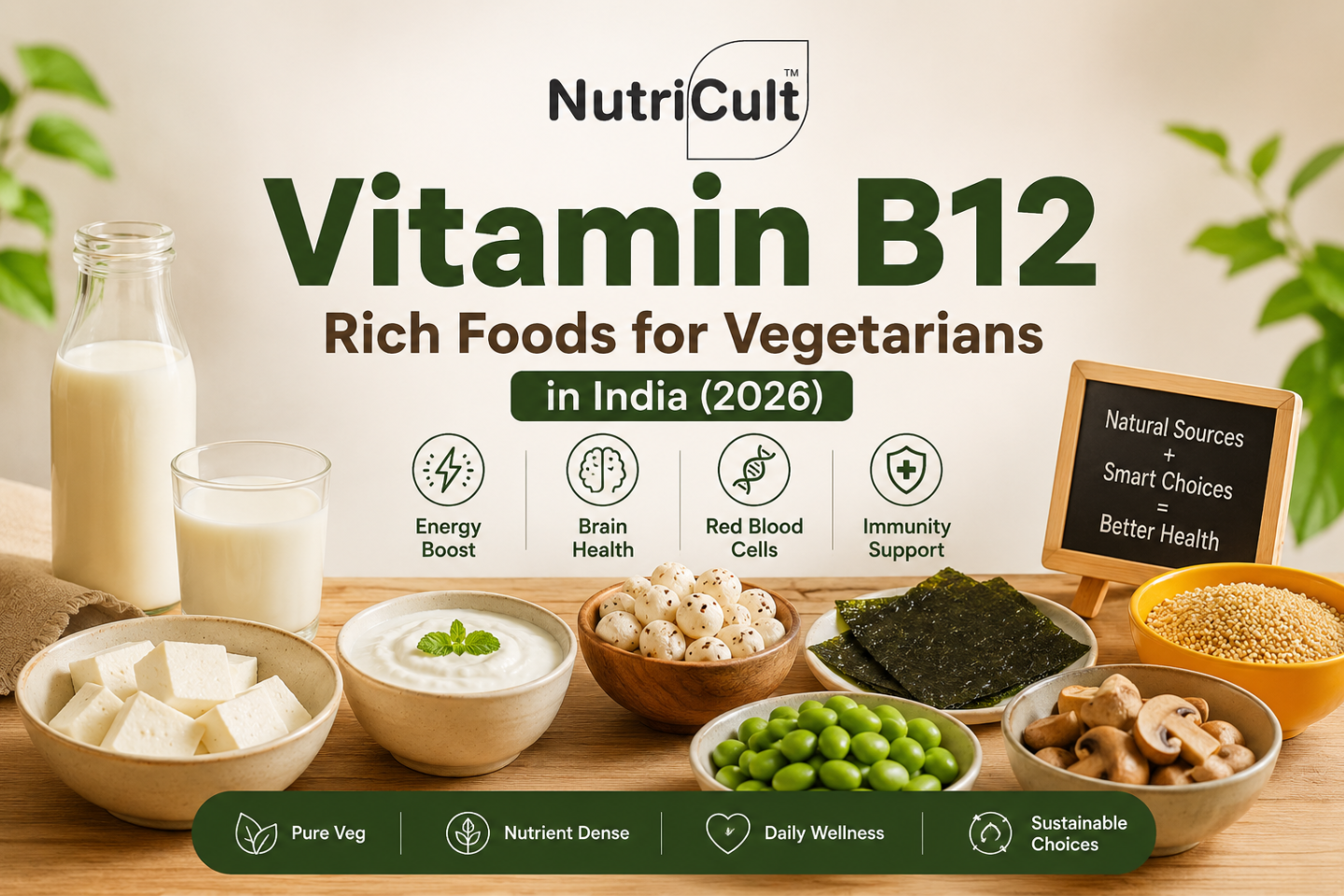
Vitamin B12 Foods for Vegetarians: A Complete, Evidence-Based Guide
Vitamin B12 is one of the few nutrients that plants simply cannot make. For anyone following a vegetarian diet in India, that single fact changes how you need to think about breakfast, lunch, and dinner. This guide walks through the vitamin B12 rich foods vegetarian diets can realistically include, how much you actually need, and where the gaps tend to show up.
Quick Answer: Best Vitamin B12 Rich Foods for Vegetarians
Milk, curd, paneer, cheese, and eggs (for those who eat them) are the most reliable vitamin B12 rich foods vegetarian diets can lean on, since B12 in plant foods is naturally absent unless a product is fortified. A glass of milk provides roughly 1.2 mcg, an egg contributes about 0.6 mcg, and fortified cereals or plant milks can add another 1 to 3 mcg per serving. The ICMR-NIN 2020 guidelines set an Estimated Average Requirement of 2 mcg per day for adults, while international bodies such as the US NIH recommend 2.4 mcg per day. Because dairy alone often falls short of covering this consistently, many nutritionists suggest combining dairy, fortified foods, and, when needed, a doctor-guided supplement.
Why Vegetarians Are at Higher Risk of Vitamin B12 Deficiency
Vitamin B12, also called cobalamin, is produced by bacteria, not by plants or animals directly. Animals accumulate it by eating bacteria-contaminated soil, grass, or feed, which is why meat, fish, and eggs end up as concentrated sources. Vegetarians who rely mainly on grains, pulses, vegetables, and fruits miss this pathway entirely unless dairy or fortified products fill the gap.
Research published in the British Journal of Nutrition, drawing on earlier work by Yajnik and colleagues, found that subclinical vitamin B12 deficiency affects a large share of vegetarian Indians, with some estimates placing prevalence as high as 70 percent in this group. A separate meta-analysis published in Cureus in 2025 also flagged vitamin B12 deficiency as a widespread and often unseen nutritional issue across the broader Indian population. These numbers matter because deficiency does not always announce itself early. Fatigue, tingling in the hands or feet, poor concentration, and low mood can build up gradually before anyone connects them to a nutrient gap.
Two more Indian-specific factors raise the stakes. First, many vegetarians in India consume dairy in modest quantities, often as tea or a small bowl of curd, rather than as a dedicated B12 source. Second, gut health issues such as low stomach acid or an imbalanced microbiome can reduce B12 absorption even when intake looks adequate on paper, which is one reason gut-supportive habits matter alongside diet. If digestion is already a concern, it is worth reading about gut health basics through everyday foods before assuming the problem is intake alone.
How Much Vitamin B12 Do You Actually Need?
The Indian Council of Medical Research and the National Institute of Nutrition updated their recommendations in 2020. For adults, the Estimated Average Requirement sits at 2 mcg per day. Older ICMR guidance from 2010 had set the figure lower, at around 1 mcg per day, so the newer standard reflects a meaningful upward revision. For comparison, the US National Institutes of Health places the Recommended Dietary Allowance for adults at 2.4 mcg per day. Pregnant and breastfeeding women need more than the general adult figure, so a doctor or dietitian should confirm exact targets during those stages.
There is no established upper limit for vitamin B12 intake, since it is water-soluble and the body does not store excess amounts in a way that causes toxicity. That said, more is not automatically better. Matching intake to your actual requirement, rather than guessing, is the more useful goal.
Vitamin B12 Rich Foods Vegetarian Diets Can Rely On
Dairy: The Backbone of a Vegetarian B12 Diet
Milk remains the single most practical vitamin B12 rich food for Indian vegetarians. A 250 ml glass of cow milk provides close to half of the adult daily requirement, and an intervention trial published in Nutrition Journal found that regular milk intake measurably improved B12 status in young vegetarian Indians who started out deficient. Curd and yogurt sit close behind milk. A standard serving of dairy yogurt typically covers between 15 and 40 percent of the adult daily target, depending on the type and portion size.
Cheese varies more widely. Swiss cheese and other hard cheeses tend to carry higher B12 levels than soft, fresh cheeses. Fifty grams of Swiss cheese can supply around 1.5 mcg, a meaningful chunk of the daily need. Paneer, the everyday Indian cottage cheese, contributes a smaller but still useful amount. Several nutrition sources estimate that a typical paneer serving covers roughly a fifth of the daily requirement, which makes it a reasonable addition rather than a standalone solution.
Eggs, If They Fit Your Diet
For lacto-ovo vegetarians who include eggs, this is one of the easier ways to close the gap. One large egg, mostly through the yolk, contributes approximately 0.6 mcg of B12. Two eggs plus a cup of yogurt can realistically cover most of the daily 2.4 mcg target used by international guidelines, making egg-and-dairy combinations one of the more efficient options available to non-vegan vegetarians.
Fortified Foods: Essential for Strict Vegetarians and Vegans
Since B12 does not occur naturally in plant foods, fortification is the only reliable plant-based route. Fortified breakfast cereals, fortified plant milks such as soy or almond milk, and nutritional yeast are the three most common fortified sources available in Indian and international markets. Fortified plant milk can provide anywhere from 1 to 3 mcg per cup, depending on the brand, so checking the label is worth the extra thirty seconds. Some fortified tofu products also carry added B12, though this varies significantly by manufacturer and is not yet standard across Indian brands.
Whole grains like ragi do not naturally contain B12, but they remain valuable for the rest of a vegetarian diet’s nutrient profile, including iron and calcium. If you are building out a broader whole-grain routine, our guide on ragi’s health benefits and how to use it covers practical ways to add it to daily meals.
Nutrition Comparison Table: Vitamin B12 Rich Foods for Vegetarians
| Food | Typical Serving | Approx. Vitamin B12 |
% of Adult ICMR EAR (2 mcg) |
| Cow milk | 250 ml (1 cup) | ~1.2 mcg | ~60% |
| Curd or yogurt | 200 g (1 cup) | 0.6 to 1.0 mcg | 30 to 50% |
| Swiss cheese | 50 g | ~1.5 mcg | ~75% |
| Paneer | 100 g | ~0.4 mcg | ~20% |
| Egg (whole) | 1 large egg | ~0.6 mcg | ~30% |
| Fortified plant milk | 250 ml | 1 to 3 mcg | 50 to 150% |
| Nutritional yeast (fortified) | 2 tbsp | 2 to 8 mcg | 100%+ |
| Butter | 100 g | ~0.17 mcg | ~8% |
Figures are approximate averages compiled from USDA FoodData Central and Indian dairy nutrition research; actual values vary by brand, fortification level, and fat content
Vitamin B12 Vegetables and Fruits: What the Evidence Actually Shows
This is a search that comes up often, and the honest answer deserves a direct statement: no vegetable or fruit naturally contains meaningful vitamin B12. Plants do not have the bacterial synthesis pathway that produces cobalamin, so items like spinach, tomatoes, bananas, or sweet potatoes will not move the needle on B12 status, no matter how nutrient-dense they are otherwise. Certain mushrooms, including shiitake and maitake, show trace amounts in some studies, but the quantities are too small to count as a dependable source.
This does not mean vegetables and fruits are irrelevant here. A well-rounded vegetarian diet still needs the iron, folate, and vitamin C these foods provide, since folate deficiency can mask or worsen the symptoms of B12 deficiency, and vitamin C supports iron absorption alongside it. Our breakdown of sweet potato benefits and nutrition is a useful next read if you want to round out the rest of your plate while you sort out B12 separately.
Signs You Might Be Falling Short
Persistent fatigue that does not improve with rest, pins-and-needles sensations in the hands or feet, pale or slightly yellow-tinged skin, memory lapses, and mood changes are the symptoms most commonly linked to low B12 status. None of these symptoms are unique to B12 deficiency on their own, which is exactly why a blood test, rather than self-diagnosis, is the appropriate next step if you notice several of them together.
Caution and Possible Side Effects
Vitamin B12 from food sources carries essentially no risk of overdose, since the body absorbs only what it needs and excretes the rest. Supplements are a different matter and should still be approached with care. High-dose B12 injections or tablets are generally well tolerated, but some people report mild acne, headache, or digestive upset when starting supplementation. Anyone with kidney disease, or anyone already taking medication that affects B12 metabolism, such as metformin or certain acid-reducing drugs, should talk to a doctor before adding a supplement rather than self-prescribing. Vitamin B12 also interacts with folate metabolism, so correcting one without checking the other can sometimes mask an underlying problem instead of solving it.
Simple Ways to Boost B12 Intake as a Vegetarian
Building B12 intake does not require a complete diet overhaul. Start by making dairy a deliberate part of at least two meals a day rather than an occasional addition to tea. Choose fortified cereals or plant milk when you are already buying packaged breakfast items, since the fortification adds B12 at no extra effort. Rotate in paneer or cheese a few times a week instead of treating it as an occasional indulgence.
Gut health plays a quieter but real role here too, since absorption depends on stomach acid and a functioning digestive tract, not just what is on your plate. If digestion feels sluggish or inconsistent, supporting it with a daily probiotic can help the rest of your nutrient intake, B12 included, get absorbed more efficiently. Vegetarians juggling multiple micronutrient gaps, B12 alongside iron, magnesium, or vitamin D, may also find it easier to track a magnesium bisglycinate supplement as part of a broader routine rather than treating each nutrient in isolation, though B12-specific supplementation should still be confirmed with a blood test first.
Finally, get tested if you suspect a gap rather than guessing. A simple blood test measuring serum B12, and sometimes homocysteine or methylmalonic acid for a fuller picture, gives a far more accurate read than symptoms alone.
Frequently Asked Questions
What are the best B12 rich foods for vegetarians in India?
Milk, curd, paneer, cheese, and fortified plant milks or cereals are the most practical vitamin b12 rich foods vegetarian diets in India can access consistently. Eggs are an additional option for those who include them.
Which vitamin B12 rich foods vegetarian diets should prioritize if dairy intake is low?
Fortified breakfast cereals, fortified soy or almond milk, and nutritional yeast are the strongest alternatives, since they often supply 1 to 8 mcg per serving depending on the brand and fortification level.
Are there vitamin B12 vegetables and fruits that vegetarians can rely on?
No. Vegetables and fruits do not naturally contain vitamin B12, since only bacteria can synthesize it. Dairy, eggs, and fortified products remain the dependable options for vegetarians.
How much vitamin B12 rich food do vegetarians need daily?
The ICMR-NIN 2020 guidelines set the adult Estimated Average Requirement at 2 mcg per day, while international RDA figures such as the US NIH’s are set at 2.4 mcg per day.
Can vegetarians get enough B12 rich foods without supplements?
Ovo-lacto vegetarians who eat dairy and eggs consistently can often meet their requirement through food alone. Strict vegetarians who avoid dairy, and vegans, typically need fortified foods or a supplement to close the gap reliably.
Is paneer a good vitamin B12 rich food for vegetarians?
Paneer contains a modest but genuine amount of B12, generally estimated around a fifth of the daily requirement per typical serving, making it a helpful contributor rather than a complete solution on its own.
Related Reads
• What Is Ragi? Benefits of Ragi, Ragi Malt, and Ragi Atta Explained
• 10 Health Benefits of Sweet Potatoes, Plus Side Effects to Know
• 9 Benefits and Uses of Lemon Peel
• The 15 Best Foods for Healthy Skin
Disclaimer
This article is for general informational purposes and does not replace professional medical advice. Vitamin B12 status varies by individual, and anyone experiencing symptoms of deficiency, or considering a supplement, should consult a doctor or registered dietitian and confirm status through a blood test before making changes to diet or supplementation.


