


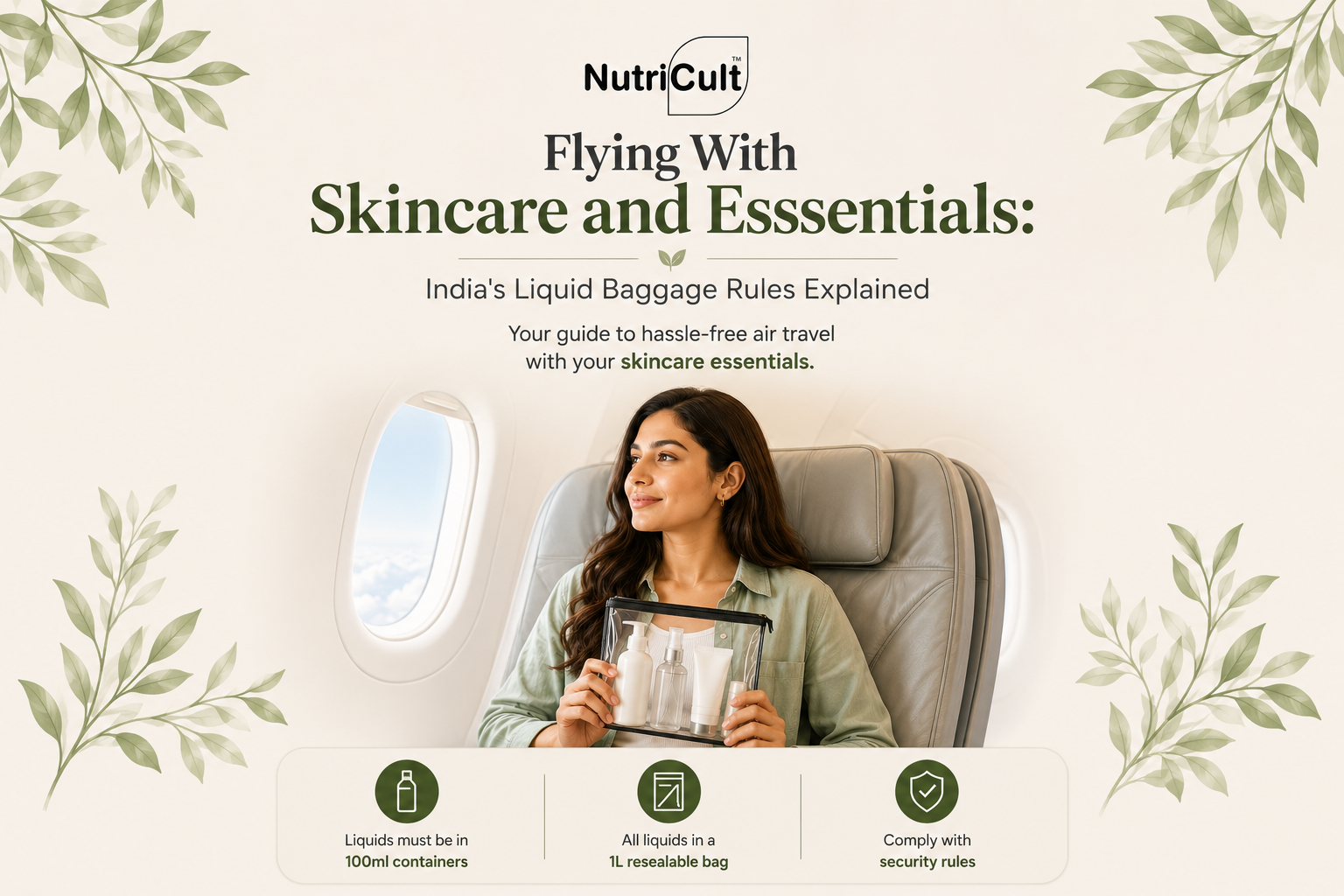
Most people pack their wellness routine for a trip the same way they pack it at home, without checking whether the airport agrees. Perfume, sunscreen, serums, liquid vitamins: all of it falls under the same aviation liquid rule, and getting the container size wrong is the single most common reason these items get pulled at security. Here is what actually travels, what needs repacking, and what skips the restriction entirely.
Quick Answer: Cabin baggage allows liquid, gel, or aerosol items only in containers of 100ml or less, all fitting inside one transparent one-litre bag, under Bureau of Civil Aviation Security (BCAS) rules. Checked baggage permits larger bottles of most cosmetics and fragrance, generally up to 500ml each. Tablets, capsules, and powders, including most supplements, are not classed as liquids and carry no volume limit in either bag.
The 100ml Rule Covers More of Your Routine Than You'd Think
India follows the Liquids, Aerosols and Gels (LAG) framework used internationally, aligned with ICAO standards and enforced domestically by the DGCA and BCAS. The rule applies to anything that pours, sprays, or spreads: perfume, sunscreen, moisturiser, liquid foundation, hair serum, and yes, liquid supplement tonics or syrups.
Container size decides admissibility, not how full the bottle is. A 150ml sunscreen tube that is half-used still counts as a 150ml container and will not clear cabin security. This catches far more travellers than perfume alone does, since a full skincare routine can easily involve five or six separate liquid items before a single fragrance bottle enters the bag.
The cabin baggage requirement in full:
- Each liquid, gel, or aerosol container must be 100ml or less.
- All containers combined must fit inside one transparent, resealable bag roughly 20cm by 20cm, with a maximum one-litre capacity.
- Only one such bag is allowed per passenger, and it must be presented separately at screening if requested.
- Solid formats, including pressed powders, stick-format cosmetics, and tablet or capsule supplements, are exempt from this rule entirely and carry no volume limit.
That last point matters more than most packing guides mention. A traveller can swap a liquid vitamin C serum for a solid stick format, or a liquid probiotic for powder-based probiotic sticks, and remove that item from the 100ml calculation altogether.
Perfume, Specifically: Cabin vs. Checked Baggage
Perfume follows the same LAG rule as everything else, with one added wrinkle: DGCA dangerous goods guidance classifies most fragrances as flammable liquids, since consumer perfumes typically run 60 to 90 percent alcohol by volume. That classification is why checked baggage still carries limits even after the strict cabin rule disappears.
In cabin baggage: perfume containers must be 100ml or less and fit in the shared one-litre liquids bag, alongside every other liquid item being carried.
In checked baggage: individual perfume bottles up to 500ml are generally permitted, with a combined 2-litre limit per passenger, provided the bottle stays in its original sealed retail packaging. Airlines including IndiGo, Air India, Vistara, and Akasa apply this same baseline.
Duty-free perfume bought after security clears the cabin rule automatically, arriving in a sealed tamper-evident bag (STEB) with the receipt visible inside. The one exception: passengers connecting from an international arrival onto a domestic Indian flight sometimes need to move that STEB liquid into checked baggage, since the domestic leg does not always honour the international exemption.
Supplements and Medication: What Actually Needs the Liquid Bag
Most daily supplements travel without any restriction at all, because most come in solid form. Capsules, tablets, and effervescent formats are not classed as LAGs and can sit anywhere in cabin or checked baggage without touching the 100ml calculation.
The rule only applies when a supplement is liquid: fish oil in syrup form, liquid multivitamins, or tonics. If a daily routine includes one of these, the same 100ml container limit applies in cabin baggage, and switching to a solid-format equivalent, such as an effervescent tablet or veg capsule, removes the restriction entirely while keeping the routine intact through the trip.
Prescription medication, including liquid medication, is generally exempt from the 100ml limit with proper documentation, though airlines increasingly ask for a doctor's note or prescription copy at screening. Carrying medication in its original labelled packaging speeds this process considerably.
Full List: What Items Are Not Allowed in Checked Luggage
Beyond liquids, Indian aviation security bans several categories from checked baggage entirely, regardless of how carefully they are packed.
Explosives and flammable materials. Fireworks, gunpowder, flares, and flammable liquids such as petrol or paint thinner cannot travel in the hold under any circumstances.
Corrosive substances. Bleach, drain cleaners, battery acid, and mercury are banned because they damage cargo holds and can contaminate other passengers' belongings if a container leaks.
Compressed gases. Propane, butane, and oxygen cylinders are prohibited from both cabin and checked baggage due to explosion risk. Medical oxygen needs prior airline approval.
Lithium batteries above certain thresholds. Spare batteries and power banks must travel in cabin baggage, not checked luggage, because of fire risk in an unmonitored hold. One spare battery under 300Wh, or two under 160Wh each, is the general cabin-only allowance.
High-proof alcohol. Beverages between 24 and 70 percent ABV are allowed checked, sealed, and capped at 5 litres total per passenger. Anything above 70 percent ABV is banned from both cabin and checked baggage.
E-cigarettes and vapes. India restricts sale and possession nationally, and BCAS extends the ban to both cabin and checked baggage.
Things Not Allowed in Flight Cabin Baggage
A separate set of restrictions governs what can pass through security into the cabin, independent of the liquid rule. Sharp objects top the list: scissors with blades longer than four inches, box cutters, and multi-tools all need to go into checked baggage instead. Sporting goods with blunt-force potential, firearms, and replica weapons are barred from the cabin outright. Laptops and tablets are allowed but must come out of their bag for separate X-ray screening, and power banks must stay with the passenger rather than in an overhead bin.
Quick Comparison Table
| Category | Cabin Baggage | Checked Baggage |
|---|---|---|
| Liquid, gel, aerosol containers | 100ml maximum each | No LAG volume limit |
| Perfume specifically | 100ml, in the shared liquids bag | Up to 500ml per bottle, 2L total |
| Tablets, capsules, powders | No restriction | No restriction |
| Alcohol content (perfume/toiletries) | Subject to LAG rule regardless of ABV | Banned above 70% ABV |
| Prescription medication | Exempt with documentation | No restriction |
A Practical Packing Checklist for Your Travel Wellness Routine
Sort liquid items first. Anything that pours or sprays, including perfume, sunscreen, and serums, needs to fit inside the one shared one-litre bag if it is travelling in the cabin. Anything solid, including most supplement formats, does not.
Where a solid alternative exists, use it. A powder or tablet supplement does the same job as a liquid one without adding to the liquids bag, which frees up space for the toiletries that only come in liquid form.
For perfume specifically, choose a travel-sized bottle or an authentic vial under 100ml when it needs to ride in the cabin. For checked baggage, keep the bottle in its original box, wrapped in a sock or clothing at the centre of the suitcase, since glass breaks more often in transit than travellers expect.
Keep medication in original labelled packaging with a prescription copy handy, and remember that food-format wellness items, like dry coconut, face their own separate restrictions independent of the liquid rule.
Frequently Asked Questions
Is perfume allowed in flight cabin baggage?
Yes, in containers of 100ml or less that fit inside the single one-litre transparent liquids bag. Larger bottles need to go in checked baggage.
Can I carry liquid supplements or vitamins on a flight?
Yes, subject to the same 100ml rule as any other liquid in cabin baggage. Tablet, capsule, or powder versions of the same supplement carry no such limit.
What items are not allowed in checked luggage?
Explosives, flammable liquids, corrosive chemicals, compressed gas cylinders, spare lithium batteries and power banks, alcohol above 70% ABV, and e-cigarettes are all barred from checked baggage.
Do solid cosmetics, like a lipstick or pressed powder, count toward the liquid limit?
No. Solid-format cosmetics are not classed as LAGs and have no volume restriction in cabin or checked baggage.
Does the 100ml rule apply to how much liquid is left in a bottle?
No. The rule is based on the container's labelled capacity, not the fill level. A half-full 150ml bottle is still treated as a 150ml container.
Can I bring prescription medication in liquid form?
Generally yes, beyond the 100ml limit, with supporting documentation such as a prescription or doctor's note. Confirm requirements with your airline before travel.
Related Reads
- Ayurvedic Skin Care for Your Skin Type: Ingredients, Treatments, and More
- The 15 Best Foods for Healthy Skin
- 9 Benefits and Uses of Lemon Peel
Explore more wellness guides on the Nutricult blog, or shop travel-friendly formats in the nutrient kits collection.
This guide reflects Bureau of Civil Aviation Security (BCAS) Liquids, Aerosols and Gels rules and Directorate General of Civil Aviation (DGCA) dangerous goods guidance applicable to departures from Indian airports. Airline-specific policies can vary slightly, so confirm current limits with your carrier before travel.


