


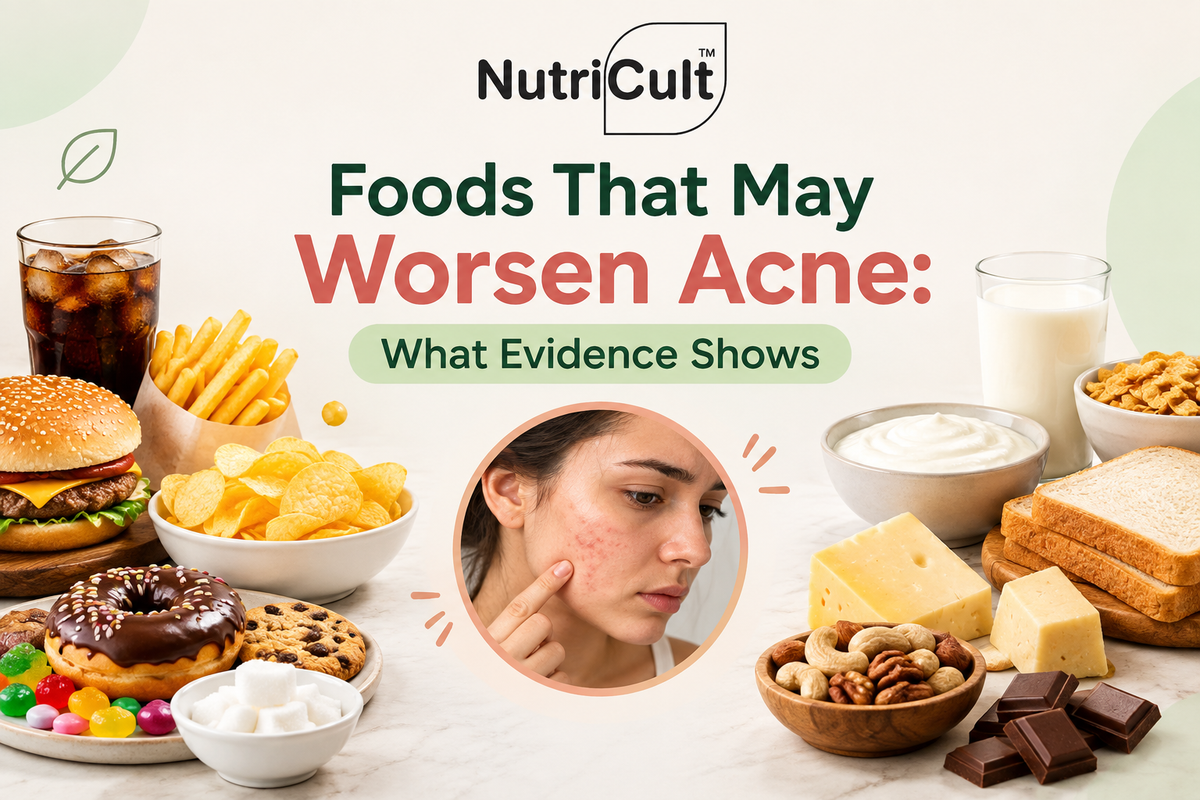
Foods That May Worsen Acne: Sugar, Dairy and High-GI Foods
Quick Answer
Evidence is strongest around dietary patterns rather than single foods, particularly diets with a high glycemic load, which several clinical trials link to worse acne severity. Dairy, especially skim milk, shows a more mixed but still notable association in observational research. Highly processed, sugar-heavy eating patterns tend to overlap with both of these factors. A food linked to acne in a study is not automatically a trigger for every individual, and no food on this list needs to be eliminated by everyone with acne-prone skin.
Introduction
If you have searched for foods to avoid for acne, you have probably found conflicting advice. One source tells you to cut out chocolate. Another insists dairy is the real problem. A third recommends eliminating sugar entirely, and a fourth adds gluten to the list. Followed together, this advice can turn into a diet with almost nothing left on it. The actual evidence is more specific and more limited than most of these lists suggest. A more useful starting point is to look at overall dietary patterns first, particularly glycemic load, and then consider individual foods only where a consistent personal pattern shows up. This article walks through what current research actually supports, without turning any single food into something to fear.
What Foods Are Most Commonly Linked With Acne?
|
Food / Dietary Pattern |
What Research Suggests |
Evidence Level |
Should Everyone Avoid It? |
|
High-glycemic-load diets |
Associated with increased acne severity in multiple randomized trials |
Moderate to fairly strong |
No, but reducing frequency may help some people |
|
Refined carbohydrates |
Contribute to glycemic load; linked to acne severity as part of that pattern |
Moderate |
No, portion and pairing with protein or fiber matter more than full elimination |
|
Sugary foods and drinks |
Frequent intake raises overall glycemic load of the diet |
Moderate |
No, occasional intake is not established as harmful |
|
Dairy, especially skim milk |
Mixed but recurring association in observational studies |
Low to moderate, mostly observational |
No, evidence does not support universal elimination |
|
Highly processed dietary patterns |
Correlate with lower dietary quality and, in some studies, worse acne |
Low to moderate |
No, focus on overall pattern rather than any single processed food |
|
Chocolate |
Small trials show mixed results, with some suggesting an effect independent of sugar or glycemic load |
Limited and inconsistent |
No, evidence is not strong enough to justify universal avoidance |
High-Glycemic Foods and Acne
Glycemic index describes how quickly a specific food raises blood glucose, while glycemic load accounts for both the glycemic index and the actual portion size eaten, giving a more realistic picture of a food's real-world effect on blood sugar. This distinction matters because a food with a high glycemic index eaten in a small portion may have a modest glycemic load, while a lower-index food eaten in a large portion can still raise blood sugar significantly.
Higher blood glucose triggers a larger insulin response, which can increase insulin-like growth factor 1 and influence androgen-related pathways connected to sebum production, both of which are relevant to acne. Multiple randomized controlled trials have found that diets lower in glycemic load reduce acne lesion counts compared with higher-glycemic control diets, and a 2022 systematic review in JAAD International, covering 34 studies, concluded that high glycemic index and glycemic load diets have a modest but statistically significant relationship with acne severity.
This does not mean all carbohydrates worsen acne. Rice, roti, and other staple carbohydrates are not automatically harmful; what matters more is overall portion, how a food is prepared, how much fiber and protein accompany it, and the broader pattern of a person's diet over weeks rather than any single meal. A deeper discussion of sugar's specific role in this pathway is covered in Nutricult's dedicated article on that topic.
Sugary Foods and Acne
Sugary drinks, desserts, and highly refined carbohydrate combinations, such as sweetened snacks made with refined flour, contribute directly to a diet's overall glycemic load. Frequent intake of these foods can push a day's eating pattern toward the higher-glycemic profile linked to worse acne severity in the research above. This does not mean sugar is uniquely responsible for acne on its own, separate from its effect on glycemic load, or that an occasional dessert will meaningfully affect your skin. The specific evidence on sugar and acne, including how much matters and how it compares with other carbohydrate sources, is examined in more depth in Nutricult's dedicated article on sugar and acne.
Dairy and Acne
Dairy has attracted more research attention than most other individual foods in acne nutrition studies. Several large observational studies, including a widely cited analysis of the Nurses' Health Study II cohort, found an association between higher milk intake, particularly skim and low-fat milk, and acne, especially when recalling high school dietary habits. A 2018 meta-analysis covering more than 78,000 participants found increased odds of acne associated with various forms of dairy intake, with skim milk showing the strongest association.
The reasons behind this pattern are not fully settled. Proposed explanations include hormonal and bioactive compounds naturally present in milk, and effects on insulin and insulin-like growth factor 1 independent of dairy's glycemic load. It is worth noting that this research is almost entirely observational, meaning it can show an association without proving that dairy directly causes acne in a given individual. Evidence for fermented dairy such as curd is more limited and less consistent than for liquid milk. Current evidence does not justify telling every person with acne to eliminate all dairy, and a fuller review of this research, including differences between dairy types, is covered in Nutricult's dedicated dairy and acne article.
Highly Processed Foods and Acne
Diets dominated by highly processed snacks, sugary beverages, refined carbohydrates, frequent desserts, and energy-dense convenience foods tend to score lower on general measures of dietary quality, and several studies link this broader pattern to worse acne outcomes. Processing itself is not proof that a food causes acne. A packaged snack made mostly of refined flour and sugar is more relevant here because of its glycemic load and low nutrient density, not simply because it went through industrial processing. The more useful lens is overall dietary pattern: how much of a typical day's food comes from minimally processed, fiber-rich sources versus refined, energy-dense ones.
What About Chocolate?
Chocolate is one of the most commonly blamed foods for acne, and the research on it is genuinely mixed. A double-blind trial using unsweetened cocoa capsules found a statistically significant increase in acne lesions in men with a history of acne over one week.
A separate randomized crossover study comparing milk chocolate to jellybeans with a matched glycemic load found that the chocolate group developed significantly more new lesions, suggesting the effect might not be fully explained by sugar or glycemic load alone. Other, older trials found no significant effect. It remains unclear which component of chocolate, if any, might be responsible, and results have not been consistent across studies.
This inconsistency means chocolate should not be treated as a confirmed acne trigger for everyone, though people who notice a personal pattern after eating it have a reasonable basis to pay attention to that.
What About Fried Food?
"Fried food causes acne" is too simplistic a claim for the current evidence. Fried foods are often part of a broader dietary pattern that includes refined carbohydrates and higher energy density, and it is this overall pattern, rather than frying as a cooking method by itself, that has a more plausible connection to acne research. There is not strong, direct evidence that frying alone is a universal acne trigger, and occasional fried food is unlikely to have a meaningful individual effect outside the context of an otherwise poor-quality diet.
Foods You Do Not Automatically Need to Avoid
Having acne does not mean you need to eliminate all carbohydrates, all dairy, fruit, rice, roti, gluten, fats, or nuts unless you have an individualized reason to do so. Removing entire food groups without evidence can create nutritional gaps and make a diet much harder to sustain, without a proportional benefit for your skin. The goal of this article is to help you focus on what the evidence actually supports, not to add more foods to a mental list of things to fear.
Indian Foods: What Should You Swap?
|
Instead of |
Consider |
Why |
|
Sugary soft drink |
Water or an unsweetened beverage |
Reduces added sugar intake and overall glycemic load |
|
Highly refined snack (namkeen, chips) |
Roasted chana, nuts, or a piece of fruit |
More nutrient-dense, lower-glycemic option |
|
Dessert-heavy snack |
Fruit with a small handful of nuts |
Adds fiber and micronutrients alongside natural sugars |
|
Refined-carbohydrate-heavy meal (maida-based items, excess white rice) |
A more balanced plate with dal, vegetables, and a moderate grain portion |
Improves overall meal composition and glycemic response |
These are practical substitutions, not guaranteed acne treatments, and traditional foods do not need to be eliminated to make use of them.
Should You Eliminate Foods or Track Your Own Patterns?
There is a meaningful difference between avoiding a food because a website said it causes acne, and noticing a genuine, repeated pattern in your own experience. Acne fluctuates naturally due to hormones, stress, sleep, and other factors, so one breakout after eating a particular food does not establish that the food caused it. If you want to investigate a possible personal trigger, keep other variables reasonably stable while you observe, rather than changing several foods and habits at once. For persistent concerns, a dermatologist or a registered dietitian can help structure a more systematic elimination and reintroduction approach.
How to Identify a Possible Food Trigger
Step 1. Track your meals and your acne pattern for a few weeks, noting new breakouts as they appear.
Step 2. Look for a food or dietary pattern that repeats across multiple flare-ups, not just a single instance.
Step 3. Avoid changing several foods simultaneously, since this makes it difficult to identify what actually mattered.
Step 4. Consider other variables at the same time, including menstrual cycle timing, stress levels, sleep quality, skincare changes, and medications.
Step 5. Discuss a persistent, suspected pattern with a dermatologist or qualified dietitian rather than relying on self-diagnosis alone.
This process can help identify a plausible personal association. It is not a diagnostic method, and it will not work for everyone, since not all acne has an identifiable dietary trigger.
A Better Question Than "What Foods Cause Acne?"
Rather than searching for a single food to blame, a more useful question is what overall dietary pattern may support healthier skin, and whether any specific foods consistently seem to affect you personally. This framing reflects what the evidence actually supports: dietary pattern matters more than any one food, and individual variation is real.
When Diet Is Not Enough
Dietary changes can complement, but should not automatically replace, appropriate acne treatment. Professional care becomes important with painful acne, nodules or cysts, scarring, persistent moderate-to-severe acne, sudden worsening, suspected hormonal causes, or acne that is affecting your quality of life. A dermatologist can offer treatments with a stronger and more direct evidence base than dietary adjustment alone, particularly for more severe presentations. For readers interested in general nutritional support alongside their skincare and dietary efforts, Nutricult's gut-health and skin-support categories, including its Probiotic Sticks and Glutathione products, are designed to complement a balanced diet rather than to treat or prevent acne on their own.
FAQs
What foods may worsen acne?
Diets with a high glycemic load, frequent added sugar, and certain dairy products, particularly skim milk, show the most consistent associations with worse acne severity in research. None of these has been shown to affect every individual the same way.
What are the worst foods for acne?
There is no definitive list of "worst" foods, but sugary drinks, refined snacks, and high-glycemic-load meals appear most often in the research linking diet to acne severity. Evidence for specific foods like chocolate remains mixed.
Should I avoid sugar if I have acne?
Reducing frequent added sugar may help by lowering your diet's overall glycemic load, which has moderate research support. Complete elimination is not established as necessary, and this topic is covered in more depth in a dedicated article.
Does dairy make acne worse?
Some studies, particularly involving skim milk, show an association with acne, but the evidence is largely observational and does not apply equally to everyone. A separate, more detailed article covers this research specifically.
Are high-glycemic foods bad for acne?
Multiple randomized trials link higher glycemic load diets to increased acne severity, making this one of the more consistent dietary associations in the research. This does not mean occasional high-glycemic foods are harmful in isolation.
Does chocolate cause acne?
Evidence is mixed. Some trials found more new lesions after chocolate consumption, even compared with a similar glycemic load, while other studies found no effect, so it should not be treated as a confirmed universal trigger.
Does fried food cause acne?
There is no strong direct evidence that frying itself causes acne. Fried foods are often eaten alongside refined carbohydrates in an overall lower-quality dietary pattern, which is the more likely relevant factor.
Should I stop eating rice if I have acne?
No. Rice does not need to be eliminated; pairing it with protein, fiber, and vegetables, and being mindful of portion size, addresses the glycemic load concern without removing a dietary staple.
What Indian foods should I avoid for acne?
No specific traditional Indian food needs to be avoided by everyone. Reducing frequent intake of sugary drinks and heavily refined snacks, while keeping dal, vegetables, and whole grains as a base, aligns with the current evidence.
Do I need to eliminate foods completely to improve acne?
No. Most of the evidence supports moderation and overall dietary pattern rather than complete elimination, and unnecessary restriction can create nutritional gaps without a clear benefit for your skin.
Related Reads
- Hormonal Acne and Nutrition: Foods That May Help
-
Best Foods for Hormonal Acne: What to Eat for Healthier Skin
-
Anti-Inflammatory Foods for Acne: What Does the Research Say?
-
21 Day Acne Diet: What to Eat and What the Evidence Says
- Hormonal Acne: Causes, Symptoms and How to Manage It
Medical Disclaimer
This article is for educational purposes only and does not replace individualized medical advice, diagnosis, or treatment from a qualified dermatologist or healthcare professional. Dietary associations described here are based on group-level research and may not apply the same way to every individual.


