


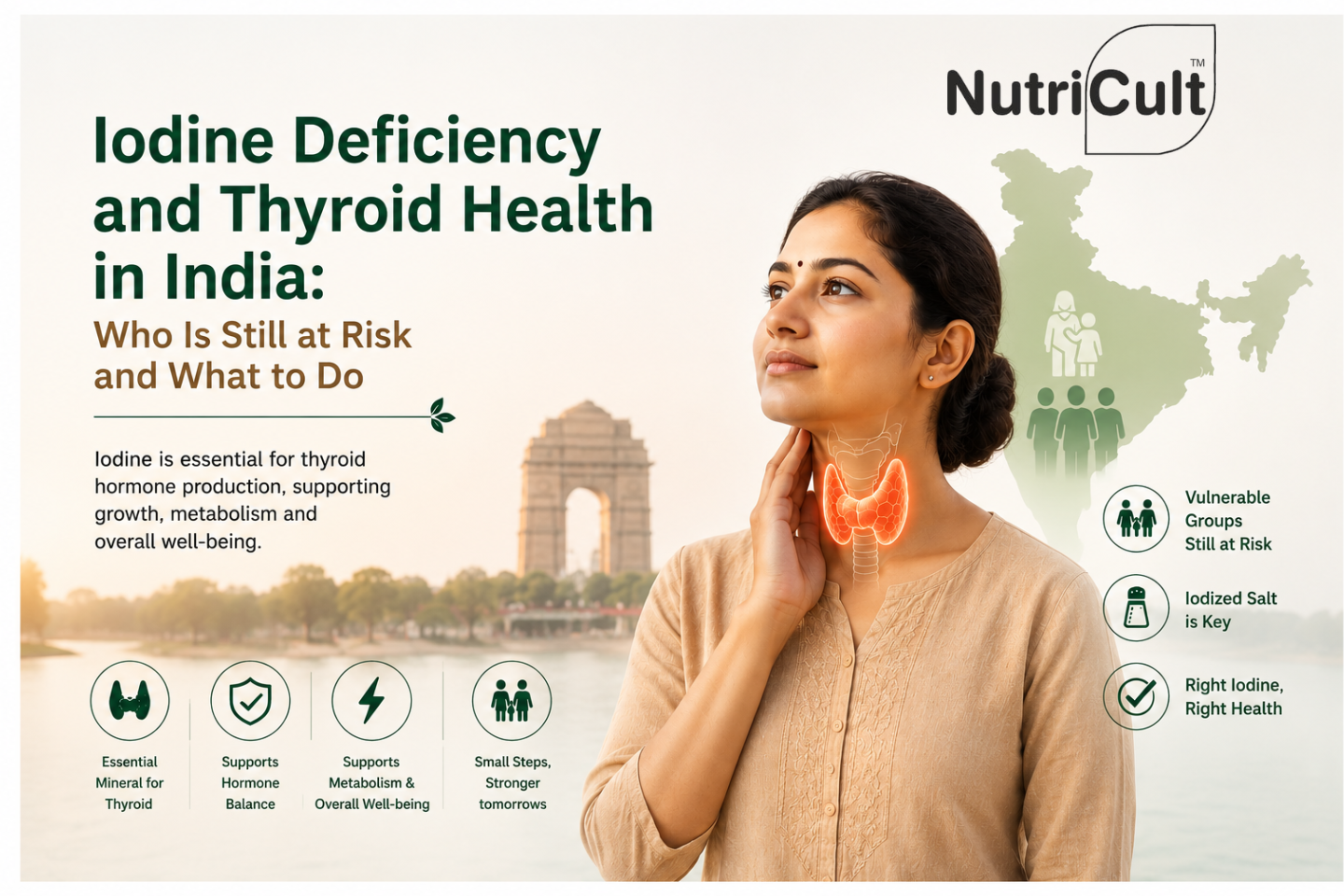
India's Iodine Progress and Remaining Gaps
Mandatory salt iodization in the 1980s dramatically reduced endemic goitre — a genuine public health success. But mild to moderate iodine insufficiency persists in significant populations: people using rock salt or sea salt, populations in iodine-poor geological regions (Himalayan belt, Deccan plateau, parts of UP and Bihar), pregnant women whose requirements are 47 percent higher than non-pregnant adults, and vegetarians in inland regions with limited dairy.
The Iodine-Thyroid Hormone Synthesis Chain
|
Step |
What Happens |
Iodine Required? |
Selenium Required? |
|
Iodide uptake |
Sodium-iodide symporter concentrates iodide 30x in thyroid follicle cells |
Yes — adequate dietary iodine essential |
No |
|
T4 synthesis |
Thyroid peroxidase (TPO) oxidizes iodide and bonds to tyrosine to form T4 (4 iodine atoms) |
Critical — insufficient iodine means insufficient T4 |
Yes — selenium required for TPO function |
|
T4 secretion |
T4 released into circulation as storage form (less active than T3) |
Raw material already incorporated |
No |
|
T4 to T3 conversion |
Selenoprotein deiodinase enzymes remove one iodine from T4 to produce active T3 |
Not required at this step |
Critical — selenium-dependent reaction |
Who Is at Iodine Risk in India in 2026
Rock Salt, Sea Salt, and Unbranded Salt Users
Rock salt (sendha namak) is used during Hindu and Jain fasting periods. Natural sea salt does not contain iodine. Loose unbranded salt sold in rural markets may not meet iodization standards. Households using these salts regularly may be substantially below iodine requirements despite broad availability of iodized salt.
Pregnant Women — The Highest-Risk Group
The Pregnancy IQ Loss Fact: Mild iodine deficiency during the first trimester — before most women know they are pregnant — permanently reduces fetal IQ by an estimated 10 to 15 points. A 2019 audit of the 20 most commonly prescribed Indian prenatal vitamins found only 4 of 20 contained iodine. Check your prenatal supplement label right now for potassium iodide or potassium iodate.
Pregnant women must check their prenatal supplement label for potassium iodide or potassium iodate. If absent, a separate 150 to 200 mcg supplement is warranted. Avoid kelp-based supplements during pregnancy — iodine content varies by up to 10-fold between batches.
Iodine Content in Indian Foods
|
Food |
Iodine per Serving |
Reliability |
Practical Note |
|
Iodized table salt (1/4 tsp = 1.5g) |
71-100 mcg (if FSSAI-compliant) |
Reliable if FSSAI-approved branded salt |
Rock salt and sea salt contain zero iodine |
|
Cow milk (240 ml) |
56-88 mcg |
Generally reliable |
Higher in winter; cattle feed iodine affects content |
|
Eggs (1 large) |
24-29 mcg |
Moderate reliability |
Range varies significantly with hen feed composition |
|
Marine fish (sardines, mackerel, 100g) |
35-55 mcg |
Moderate |
Regular coastal fish consumption contributes meaningfully |
|
Freshwater fish (rohu, catla, 100g) |
10-30 mcg |
Low |
Significantly less iodine than marine fish |
Goitrogens: The Correct Context
|
Food |
Mechanism |
Cooking Effect |
Practical Guidance |
|
Cauliflower, cabbage, broccoli |
Myrosinase produces isothiocyanates that block iodine uptake by thyroid |
Cooking destroys myrosinase — compounds largely inactivated |
Cooked at normal portions: safe for iodine-sufficient individuals |
|
Soy (large amounts) |
Isoflavones inhibit thyroid peroxidase activity |
Fermentation reduces isoflavones significantly |
Normal tofu/soy food consumption safe; large isoflavone supplements in hypothyroidism: caution |
|
Pearl millet (bajra), sorghum (jowar) |
C-glycosyl flavonoids; mild goitrogenic activity |
Some reduction with cooking |
At normal dietary portions with adequate iodine: not clinically significant |
Autoimmune vs Iodine-Deficiency Hypothyroidism: The Critical Distinction
|
Feature |
Iodine-Deficiency Hypothyroidism |
Hashimoto's Thyroiditis (Autoimmune) |
|
Root cause |
Insufficient iodine for T4/T3 synthesis |
Immune-mediated destruction of thyroid tissue |
|
TPO antibodies |
Normal — no autoimmune attack |
Elevated above 35 IU/mL in most cases |
|
Iodine supplementation effect |
Corrects the condition; normalizes thyroid function |
Can trigger Wolff-Chaikoff effect and worsen autoimmune inflammation — potentially harmful |
|
Selenium 200 mcg daily |
Not primary treatment for iodine deficiency type |
Multiple RCTs show significant TPO antibody reduction — most evidence-based nutritional intervention for Hashimoto's |
|
Prevalence in urban India |
Uncommon since iodization programme |
Dominant form — what most diagnosed hypothyroid urban Indian women actually have |
Safe Iodine Supplementation Protocol
- Pregnant women without iodine in prenatal supplement: add 150-200 mcg potassium iodide daily
- Breastfeeding women: requirement is 290 mcg daily; supplement 150 mcg if not using iodized salt consistently
- Rock salt or sea salt users: switch to FSSAI-approved iodized table salt, or add a 150 mcg potassium iodide supplement
- Strict vegetarians in iodine-poor geological zones with limited dairy and eggs: 150 mcg supplement
Do not supplement iodine if diagnosed with Hashimoto's thyroiditis without thyroid specialist guidance. Excess iodine can trigger acute autoimmune thyroid disease flares in susceptible individuals.
FAQ
Is Himalayan pink salt a reliable iodine source?
No. Himalayan pink salt contains trace iodine at highly variable concentrations — consistently insufficient to meet daily requirements. Marketing claims suggesting it provides adequate iodine are not supported by analytical data. Use FSSAI-approved iodized table salt, or supplement separately if you prefer to use Himalayan or sea salt for culinary reasons.
My TSH is 3.5 and my doctor says it is normal. Should I be concerned?
TSH 3.5 is within the standard reference range and is clinically normal for most non-pregnant adults. For women planning pregnancy, some reproductive endocrinologists target below 2.5. If fatigue, hair loss, cold intolerance, and constipation accompany TSH 3.5, test anti-TPO antibodies — this pattern may represent early Hashimoto's warranting monitoring and potential intervention.


