


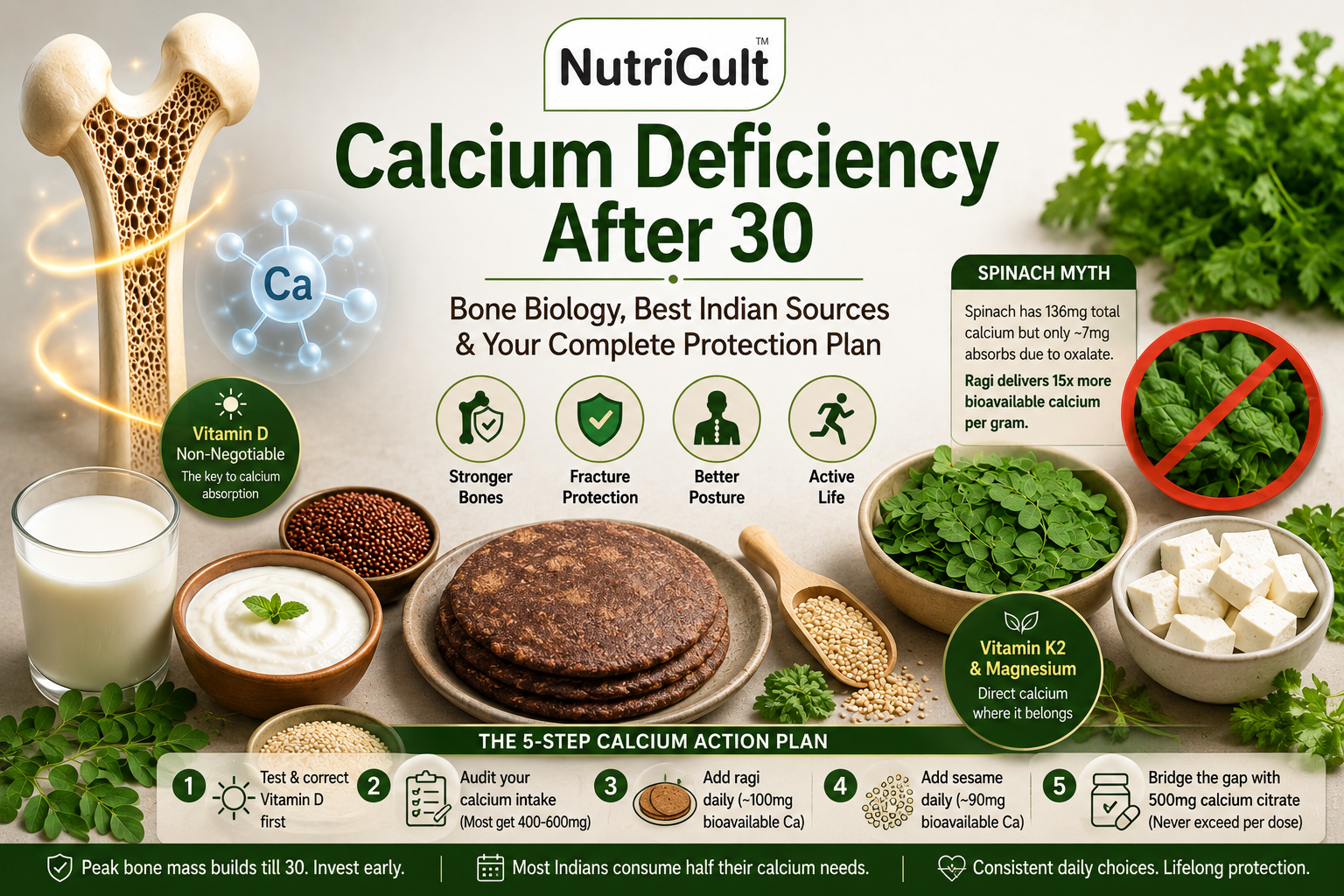
The 30-Year Deadline for Bone Mass
Bone is dynamically renovated throughout life. Osteoblasts build; osteoclasts resorb. In youth, building dominates, and bone mineral density accumulates, peaking between ages 25 and 30. A 10 percent higher peak bone mass delays the onset of osteoporotic fracture risk by approximately one decade, a permanent consequence of nutrition choices made in youth.
Post-menopausal Indian women lose 2 to 5 percent of bone density annually in the first 5 to 7 years after estrogen withdrawal without intervention. No supplement taken after 50 can restore bone capital never deposited before 30. Calcium investment in childhood, adolescence, and early adulthood is irreplaceable.
Calcium Bioavailability in Indian Foods: What You Actually Absorb
|
Food |
Total Ca per 100g |
Absorption % |
Bioavailable Ca |
Indian Kitchen Note |
|
Sesame seeds (til, hulled) |
975 mg |
~21% |
~205 mg per 30g serving |
Use daily in chutney, ladoo, or sprinkled on rice |
|
Ragi (finger millet, raw) |
344 mg |
~28-32% |
~100-110 mg per 100g |
Ragi roti or mudde at one meal daily — best plant calcium in India |
|
Moringa (drumstick) leaves |
185 mg |
~52% |
~96 mg per 100g |
Add to dal and sambar; excellent bioavailability; also provides iron |
|
Cow milk, full-fat (240 ml) |
276 mg |
32% |
~88 mg per glass |
Reliable; consistent bioavailability |
|
Curd/dahi (200g) |
240 mg |
32% |
~77 mg per serving |
Probiotic co-benefit; practical daily source |
|
Paneer (100g) |
208 mg |
32% |
~67 mg |
Widely consumed; good density |
|
Calcium-set tofu (100g) |
350 mg |
~31% |
~109 mg |
Check ingredients for calcium sulphate or chloride |
|
Spinach (palak, 100g cooked) |
136 mg |
~5% (oxalate binding) |
~7 mg only |
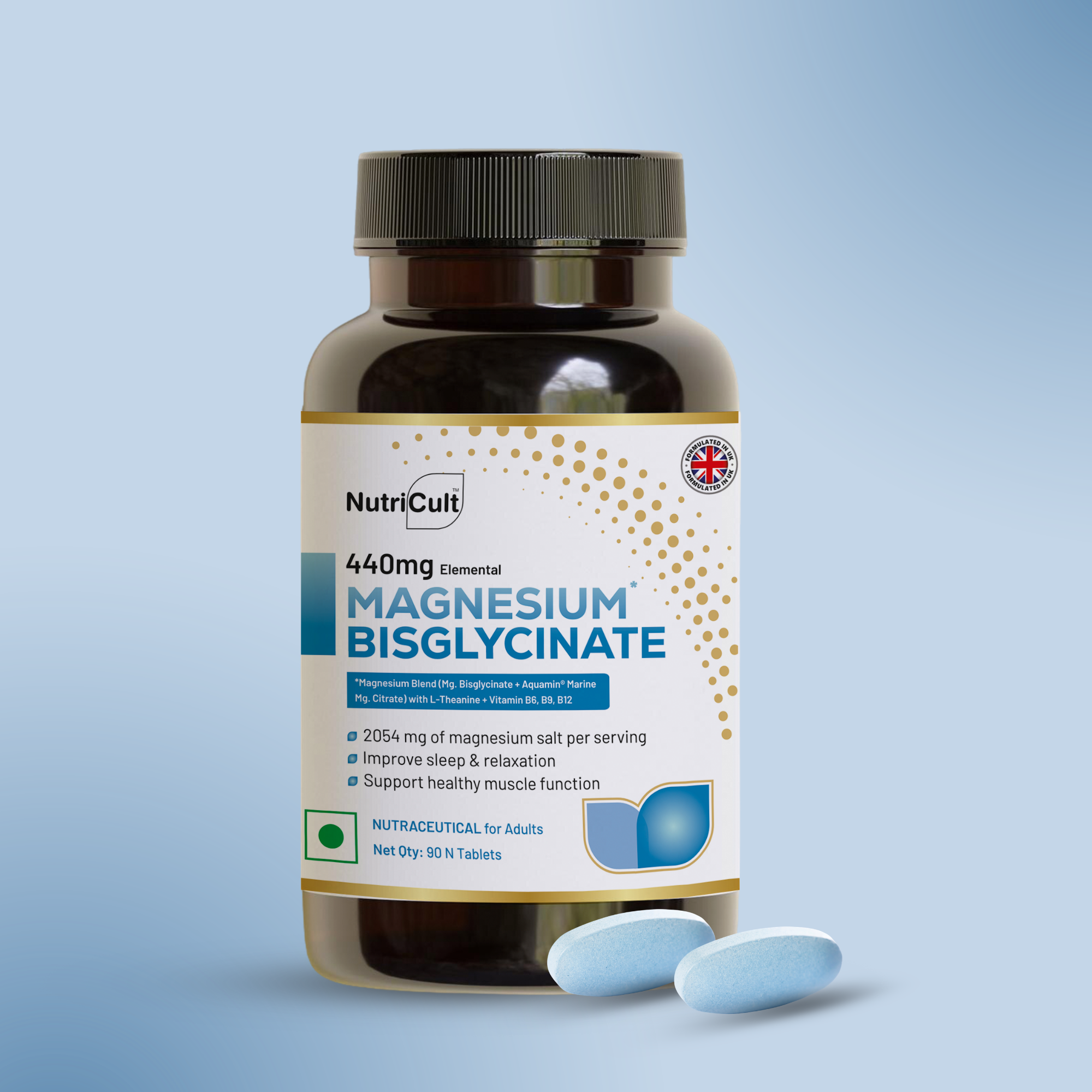
Do NOT count toward calcium targets — oxalate binds 95% of calcium Explore Nutricult wellness essentials designed to complement your daily routine. Discover Magnesium Bisglycinate for daily wellness, L-Glutathione Effervescent Tablets, and Glutathione Gluta Builder Veg Capsules. Shop your favourites directly from Nutricult. |
Spinach Calcium Myth: Spinach contains 136 mg total calcium per 100g, but its oxalic acid (750 mg per 100g) binds calcium so effectively that only ~5% absorbs, approximately 7 mg per serving. Ragi delivers 15 times more bioavailable calcium per gram. Continue eating spinach for iron and folate, but never count it toward your daily calcium target.
Calcium Requirements by Life Stage
|
Life Stage |
Daily Requirement |
Deficiency Consequence |
Priority Strategy |
|
Adolescents 9-18 years |
1,300 mg |
Reduced peak bone mass — permanent and irreversible |
Most critical window; daily milk, ragi, and sesame are essential |
|
Adults 19-30 years |
1,000 mg |
Failure to maximize peak bone mass reserve |
3 dairy servings daily plus ragi at one meal |
|
Adults 31-50 years |
1,000 mg |
Accelerating silent bone loss begins |
Consistent 1,000 mg daily; Vitamin D correction first |
|
Post-menopausal women |
1,200 mg |
Rapid 2-5% per year bone loss; osteoporosis |
500 mg calcium citrate if diet inadequate; Vitamin D + K2 |
|
Men above 70 |
1,200 mg |
Hip fracture risk significantly elevated |
Supplement; Vitamin D essential for muscle and bone |
|
Pregnant women |
1,000 mg |
Fetal skeleton draws calcium from maternal bone if intake inadequate |
Increase dairy; prenatal supplement must include calcium |
The Vitamin D Dependency: Non-Negotiable
Calcium absorption from the intestine requires Vitamin D. Without adequate 25(OH)D (optimally 30 to 60 ng/mL), only 10 to 15 percent of dietary calcium absorbs. With optimal Vitamin D, absorption rises to 30 to 40 percent. A Vitamin D-deficient person consuming 1,000 mg calcium daily effectively absorbs only 100 to 150 mg, barely above baseline. Always correct Vitamin D before optimizing calcium supplementation.
Vitamin K2 and Magnesium: The Supporting Team
|
Nutrient |
Role in Bone Health |
Indian Status |
Action |
|
Vitamin K2 (MK-7 form) |
Activates osteocalcin which binds calcium to bone matrix; prevents arterial calcification from calcium supplements |
Very low — Indian diet lacks fermented natto; eggs provide small amounts |
90-180 mcg MK-7 daily supplement; take alongside Vitamin D and calcium |
|
Magnesium |
Required for Vitamin D activation; calcium transport into bone; component of bone mineral |
Frequently deficient; refined grain diets low in magnesium |
300-400 mg/day from pumpkin seeds, sesame; consider magnesium glycinate supplement |
|
Protein |
Collagen matrix provides scaffold for calcium mineralization; low protein reduces bone formation rate |
Below-optimal in many Indian vegetarians |
1.0-1.5g per kg body weight; inadequate protein impairs bone architecture |
Calcium Supplements: Forms and the 500 mg Rule
|
Form |
Elemental Ca % |
Stomach Acid Required? |
Best For |
Key Caution |
|
Calcium carbonate |
40% |
Yes — must take with food |
Most economical; most widely available |
Avoid in PPI users and older adults with low stomach acid; constipation common |
|
Calcium citrate |
21% |
No — can take empty stomach |
Older adults; PPI/antacid users; digestive issues |
More expensive; requires more tablets per dose |
|
Calcium algae source (Aquamin) |
~32% |
Not required |
Food-matrix absorption advantage; trace mineral co-benefit |
Premium pricing; genuine bioavailability advantage |
The 500 mg Per Dose Rule: Intestinal calcium transport saturates at approximately 500 mg per dose. Taking 1,000 mg at once absorbs less efficiently than two separate 500 mg doses taken hours apart. Always split calcium supplementation. The cardiovascular concern about calcium supplementation is specific to large single doses; split-dose supplementation does not carry this risk.
5-Step Calcium Action Plan
- Test Vitamin D (25(OH)D) first and correct deficiency to 30-60 ng/mL with Vitamin D3. This is the gating factor for all calcium absorption.
- Audit your actual calcium intake over 3 days. Most Indians discover they are at 400-600 mg. Know your baseline before supplementing.
- Add ragi to one meal daily, one ragi roti or 100g ragi mudde provides ~100-110 mg bioavailable calcium alongside fibre and iron.
- Add one tablespoon of sesame to daily cooking, chutneys, or food, approximately 90 mg bioavailable calcium per tablespoon.
- Bridge the remaining gap with 500 mg calcium citrate at dinner (with food) if total from food is below 800 mg. Never exceed 500 mg per dose or 1,200 mg total daily.
FAQ
Can I get enough calcium without any dairy products?
Yes, with deliberate planning. A non-dairy day reaching 1,000 mg bioavailable calcium: two ragi rotis (200 mg), one tablespoon sesame in cooking (90 mg), 100g calcium-set tofu (109 mg), 100g moringa leaves in dal (96 mg), 30g mixed seeds (50 mg), 200g cooked legumes (40 mg). This requires consistent knowledge and planning at every meal. Most people find moderate dairy alongside targeted plant sources more practical.
Do calcium supplements increase kidney stone risk?
Dietary calcium reduces oxalate kidney stone risk by binding dietary oxalate in the gut. Calcium supplements taken without food miss this protective mechanism. Always take calcium supplements with food. If you have a history of oxalate kidney stones, choose calcium citrate specifically, it poses the lowest stone risk among supplement forms.


