


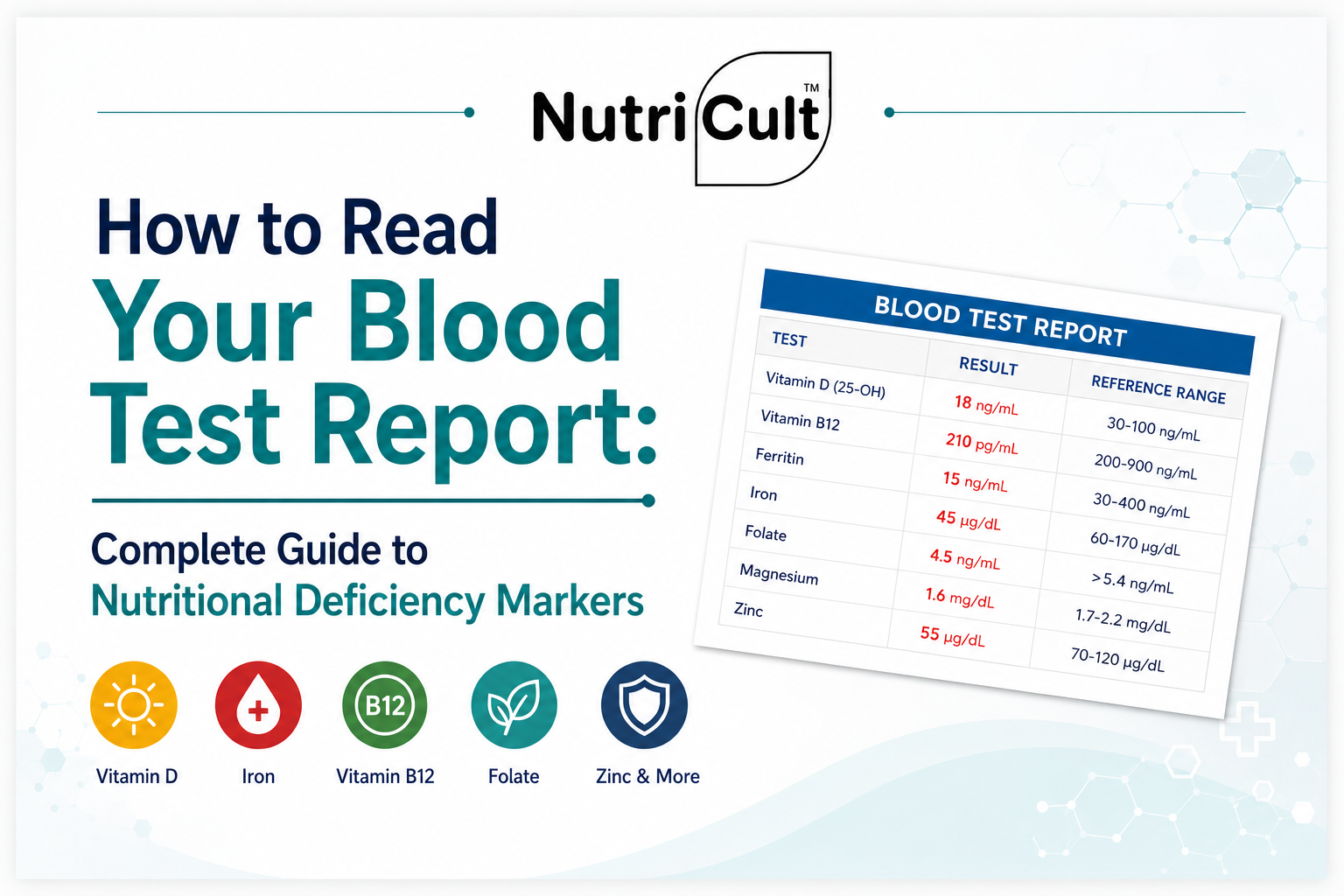
Why Your Report Contains More Than You Are Told
A standard Indian annual health check-up returns a multi-page report with dozens of values. Physicians review only critically abnormal numbers. Most nutritional deficiencies sit just inside the reference range — not flagged, but far from optimal. Learning to read your own report transforms a passive annual ritual into an actionable health tool.
The CBC: Reading Beyond Haemoglobin
Haemoglobin — The Consequence Marker
Haemoglobin reflects whether anaemia has developed — the downstream consequence of a deficiency, not the deficiency itself. Normal haemoglobin does not rule out iron deficiency, B12 depletion, or functional nutritional inadequacy.
|
Population |
Normal Hb (g/dL) |
Anaemia Threshold |
Immediate Next Step |
|
Adult men |
13.5 to 17.5 |
Below 13.0 |
Serum ferritin; iron studies; B12 and folate |
|
Adult women |
12.0 to 16.0 |
Below 12.0 |
Serum ferritin first to rule out iron deficiency |
|
Pregnant women |
11.0 to 14.0 |
Below 11.0 |
Iron studies; B12; folate urgently |
|
Children 6-12 years |
11.5 to 15.5 |
Below 11.5 |
Serum ferritin; dietary history |
MCV — Your Best Deficiency Type Indicator
MCV (Mean Corpuscular Volume) measures average red blood cell size in femtolitres. Normal: 80-100 fL. This single number narrows diagnostic possibilities before ordering any additional test.
|
MCV Value |
Cell Size |
Primary Cause |
Next Test |
|
Below 80 fL |
Microcytic (small) |
Iron deficiency; thalassaemia trait |
Serum ferritin, TIBC, transferrin saturation; Hb electrophoresis |
|
80-100 fL |
Normocytic |
Acute blood loss; early mixed deficiency |
Reticulocyte count; check B12 even with normal MCV if symptomatic |
|
Above 100 fL |
Macrocytic (large) |
B12 deficiency; folate deficiency; hypothyroidism |
Serum B12, serum folate, TSH; alcohol history |
RDW and Platelet Count
RDW (Red Cell Distribution Width) measures variability in red cell sizes. Normal: below 14.5 percent. High RDW with low MCV indicates early iron deficiency. High RDW with high MCV indicates B12 or folate deficiency. High RDW with normal MCV suggests mixed deficiency of iron and B12 simultaneously — each pulls MCV in opposite directions so it appears normal while both cause fatigue.
Iron Studies: The Four Tests That Matter
|
Test |
Normal Range |
Iron Deficiency Finding |
Clinical Importance |
|
Serum Ferritin |
Women 12-150; Men 30-300 ng/mL |
Below 12 = definite; 12-30 = functional depletion |
Most sensitive single iron marker; must request separately from CBC |
|
TIBC |
250-370 mcg/dL |
Elevated — body makes more transport protein when iron low |
High TIBC + low ferritin + low saturation = classic iron deficiency triad |
|
Transferrin Saturation |
20-50% |
Below 15% confirms functional deficiency |
Immediate supplementation warranted at below 10% |
|
Serum Iron |
60-170 mcg/dL |
Low; fluctuates with meals |
Less reliable alone; use alongside ferritin and TIBC |
Clinical Rule: Ferritin below 30 ng/mL with fatigue, hair loss, brain fog, or poor exercise tolerance warrants iron supplementation even with normal haemoglobin. This is Stage 1 iron deficiency — impairs function, responds to supplementation, prevents anaemia.
Vitamin D: Interpreting 25(OH)D
The correct test is serum 25-hydroxyvitamin D (calcidiol) — the accurate reflection of Vitamin D body stores. Some labs report in nmol/L; divide by 2.497 to convert to ng/mL.
|
25(OH)D Level |
Classification |
Consequences |
Action |
|
Below 10 ng/mL |
Severe deficiency |
Osteomalacia; severe immune impairment |
Medical supervision; loading dose protocol |
|
10-19 ng/mL |
Deficiency |
Bone loss; immune impairment; fatigue; depression risk |
2,000 IU D3 daily with fat-containing meal; retest in 3 months |
|
20-29 ng/mL |
Insufficiency |
Below optimal bone, immune, metabolic function |
1,000-2,000 IU D3 daily; optimize sun exposure |
|
30-60 ng/mL |
Sufficiency |
Target range for most Indian adults |
Maintain with 1,000 IU D3 if sun exposure is limited |
|
40-60 ng/mL |
Optimal in pregnancy |
Best for fetal bone and immune development |
Supplement to achieve this range pre-conception |
|
Above 100 ng/mL |
Potentially toxic |
Hypercalcaemia; kidney calcification risk |
Stop supplementing; retest in 4-6 weeks |
Vitamin B12: Why the Laboratory Range Misleads Indian Vegetarians
Most Indian labs flag B12 below 180-200 pg/mL as deficient. Neurological symptoms of B12 deficiency are documented at levels up to 350 pg/mL when methylmalonic acid (MMA) and homocysteine are elevated. Millions of Indian vegetarians sit in the borderline zone — never flagged, yet functionally deficient.
|
Serum B12 |
Classification |
Clinical Reality |
Action |
|
Below 150 pg/mL |
Definite deficiency |
Active neurological damage risk |
Supplement immediately; rule out pernicious anaemia |
|
150-200 pg/mL |
Deficient |
Significant neurological impairment risk if prolonged |
1,000 mcg methylcobalamin or cyanocobalamin daily |
|
200-300 pg/mL |
Borderline grey zone |
Functional deficiency in symptomatic vegetarians |
Supplement if vegetarian, symptomatic, on metformin, or PPIs |
|
300-500 pg/mL |
Low-normal |
Marginal in high-risk groups |
Dietary improvement; supplement if intake cannot reliably change |
|
500-900 pg/mL |
Optimal |
All functions supported |
Maintain; continue supplement if vegetarian |
|
Above 900 pg/mL (unsupplemented) |
Elevated |
Investigate liver disease or myeloproliferative disorder |
Liver function test; haematology review |
Confirmatory tests when B12 is borderline: plasma methylmalonic acid (MMA; normal below 0.27 mcmol/L) and total homocysteine (normal below 15 mcmol/L). Either elevated confirms functional B12 deficiency requiring treatment even when serum B12 has not crossed the laboratory's flagging threshold.
Thyroid Function Tests
|
Test |
Normal Range |
Hypothyroid Pattern |
Nutritional Connection |
|
TSH |
0.4-4.0 mIU/L |
Elevated — pituitary over-stimulating sluggish gland |
Iodine is raw material; selenium deficiency impairs T4-to-T3 conversion |
|
Free T4 |
0.8-1.8 ng/dL |
Low or low-normal |
Iodine provides the four iodine atoms in T4 structure |
|
Free T3 |
2.3-4.2 pg/mL |
Low (selenium-dependent deiodinases convert T4 to T3) |
Selenium 200 mcg daily reduces TPO antibodies in multiple RCTs |
|
TPO Antibodies |
Below 35 IU/mL |
Elevated in Hashimoto's — most common Indian hypothyroid cause |
Anti-inflammatory diet; selenium; Vitamin D correction |
|
Anti-TG Antibodies |
Below 115 IU/mL |
Elevated in Hashimoto's in 30-40% of cases |
Check alongside TPO for complete autoimmune picture |
Pregnancy TSH Rule: TSH above 2.5 mIU/L in the first trimester is associated with impaired fetal neurodevelopment even within the standard normal range. Pregnant women should have TSH reviewed against pregnancy-specific targets.
Blood Sugar: Why Fasting Glucose Alone Is Insufficient
|
Test |
Normal |
Prediabetes |
Diabetes |
India-Specific Importance |
|
Fasting glucose |
Below 100 mg/dL |
100-125 mg/dL |
Above 126 on two occasions |
Misses postprandial impairment; false negatives common |
|
HbA1c |
Below 5.7% |
5.7-6.4% |
6.5% or above |
Most reliable single marker; 90-day glucose average |
|
2-hour postprandial |
Below 140 mg/dL |
140-199 mg/dL |
200 mg/dL+ |
Catches impaired glucose tolerance invisible on fasting tests alone |
|
Fasting insulin |
2-25 mIU/L (optimal 4-8) |
Elevated with normal glucose = insulin resistance |
-- |
Best early insulin resistance marker; rarely ordered but most informative |
Lipid Profile: What Predicts CVD Risk in Indians
|
Marker |
Optimal |
High Risk |
Indian-Specific Context |
|
LDL Cholesterol |
Below 100 mg/dL |
Above 160 mg/dL |
Indians have smaller denser LDL particles — more atherogenic at equivalent levels |
|
HDL Cholesterol |
Above 60 mg/dL |
Below 40 men; below 50 women |
Structurally lower HDL in Indians; very low HDL is a major CVD driver |
|
Triglycerides |
Below 150 mg/dL |
Above 200 mg/dL |
High-carb diets primary driver; omega-3 and berberine most effective interventions |
|
Non-HDL Cholesterol |
Below 130 mg/dL |
Above 160 mg/dL |
Better CVD predictor than LDL alone in Indian populations |
|
Lp(a) |
Below 30 mg/dL |
Above 50 mg/dL |
Genetically elevated in 25-30% of South Asians; not lifestyle-reducible |
Tests Routinely Missing From Indian Panels — Request These
- Serum ferritin: absent from most CBC panels; essential to detect iron depletion before anaemia develops
- 25(OH)D: almost never in standard panels despite near-universal Indian deficiency; Rs. 500-800 to add
- Serum B12: excluded from many panels; essential for vegetarians, metformin users, PPI users
- HbA1c: more reliable than fasting glucose alone; often omitted from basic panels
- Fasting insulin: earliest insulin resistance marker; approximately Rs. 300-500 extra
- High-sensitivity CRP: systemic inflammation; independent cardiovascular risk predictor
- Homocysteine: elevated with B12, folate, or B6 deficiency; independent cardiovascular risk marker
- Lp(a): check once if family history of premature cardiovascular disease
Annual Testing Tiers
Tier 1: All Adults Above Age 25
- CBC with differential (Hb, MCV, RDW, WBC, platelets)
- Serum ferritin — request separately
- Serum 25(OH)D — request separately
- Serum B12 — essential for vegetarians
- TSH (thyroid stimulating hormone)
- Fasting glucose and HbA1c
- Full lipid profile with non-HDL calculation
- Liver function (ALT, AST, GGT, bilirubin, albumin)
- Kidney function (creatinine, eGFR, uric acid)
Tier 2: Add From Age 35
- Fasting insulin
- High-sensitivity CRP
- Homocysteine
- Lp(a) if family history of premature cardiovascular disease
FAQ
My report says within normal limits everywhere but I feel chronically unwell. How?
Laboratory reference ranges include 95 percent of an apparently healthy reference population — which includes many nutritionally suboptimal people. Within normal limits confirms values fall within the statistical range, not that they support optimal function for you specifically. Ferritin of 14 ng/mL is above most labs' lower limit. It is not a level at which normal hair cycling, sustained energy production, or adequate immune cell generation can be expected. Use symptoms alongside numbers — never numbers alone.
Which three tests give the most nutritional information per rupee?
Serum ferritin (covers the most common undiagnosed deficiency — iron depletion without anaemia), serum 25(OH)D (covers near-universal Indian Vitamin D deficiency), and serum B12 (essential for vegetarians; the only way to detect deficiency before irreversible neurological damage). These three at NABL-accredited labs cost approximately Rs. 600-1,200 combined.


