


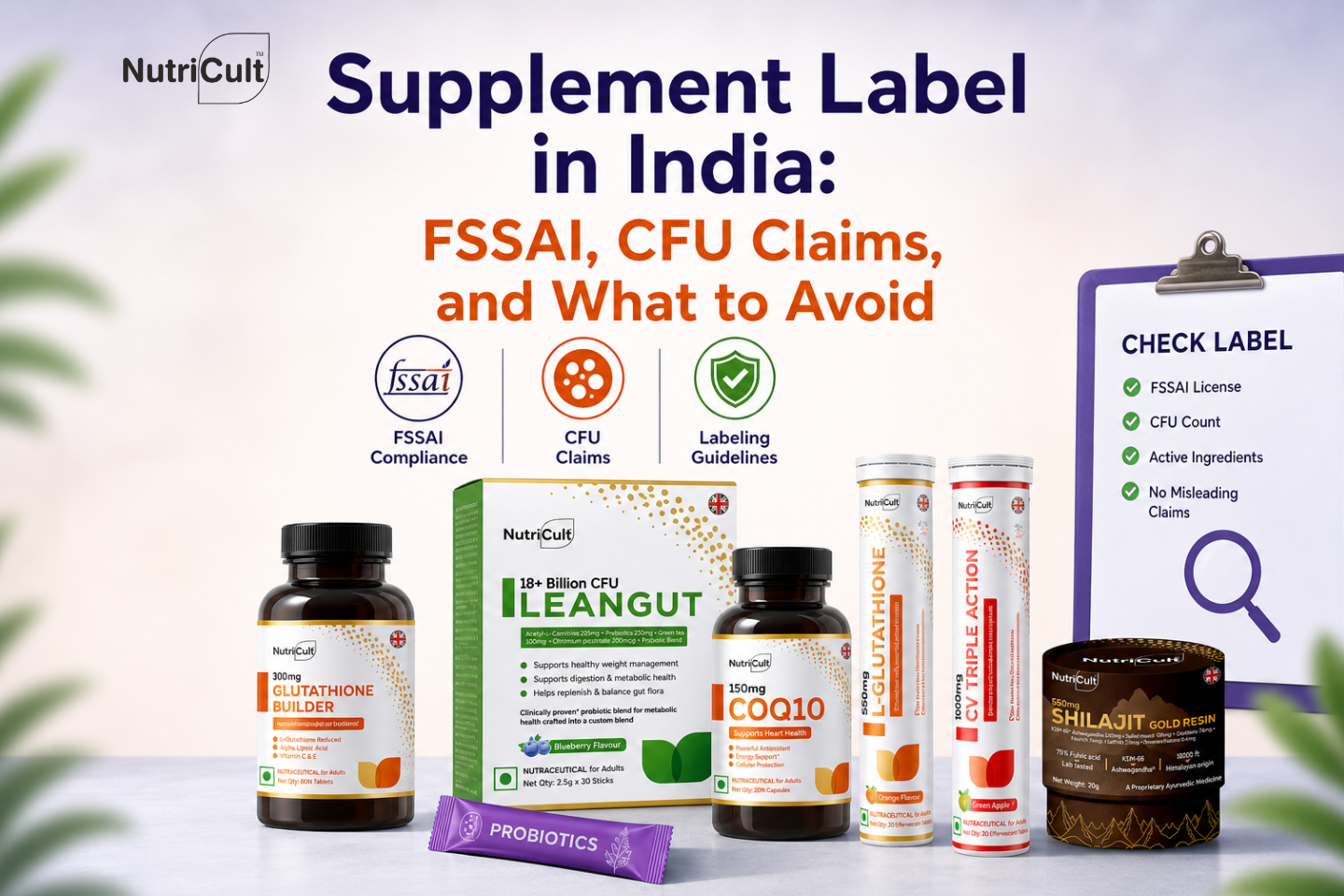
FSSAI Compliance — What the Licence Number Tells You
Every food supplement sold legally in India must carry an FSSAI (Food Safety and Standards Authority of India) licence or registration number. The format is a 14-digit number beginning with a state code. A valid FSSAI number means the product has been registered under applicable food safety regulations and the manufacturer's facility has been audited for compliance. You can verify any FSSAI number at fssai.gov.in/mFoodBiz. Absence of an FSSAI number on any supplement sold in India is a serious red flag — it indicates the product is either unregistered or counterfeit. For imported products, look for FSSAI import licence compliance.
Understanding CFU Claims in Probiotics
CFU stands for Colony Forming Units — the number of viable bacteria per serving. Three critical questions to ask about any probiotic's CFU claim:
(1) Is this at manufacturing or at expiry? Good manufacturers guarantee CFU at expiry — which is lower but more meaningful for efficacy.
(2) Are individual strain CFU counts listed, or just a total? A product claiming '50 billion CFU' from a blend of 10 strains gives you 5 billion per strain on average — which may be below therapeutic thresholds for each strain.
(3) Are strain names given in full species + strain designation? 'Lactobacillus acidophilus NCFM' is a specific, researched strain. 'Lactobacillus blend' tells you nothing clinically.
Ingredient Standardisation Markers — The Potency Guarantee
Botanical extracts only deliver therapeutic effects at the concentrations used in clinical trials. Standardisation to a specific percentage of active compounds is the mechanism that guarantees this. Key markers to look for: KSM-66 Ashwagandha (5% withanolides) — if you see this on the label, you know the ashwagandha dose per capsule contains 50 mg withanolides per gram. Shilajit (specified % fulvic acid) — quality shilajit resin should specify fulvic acid content. Products listing only 'shilajit extract' without a standardisation percentage are typically low-potency preparations. Curcumin (95% curcuminoids) — plain turmeric powder contains 2 to 5% curcumin; standardised extract delivers 95%. The price difference reflects the standardisation cost.
Red Flags in Supplement Labels
Proprietary blends without individual ingredient doses — a legal way to include ingredients at sub-therapeutic amounts while listing them prominently. No third-party testing — quality brands display NABL, NSF, or USP certification for batch testing. Overclaimed benefits — Indian FSSAI regulations restrict specific disease claims on supplements. Phrases like 'cures', 'treats', or 'reverses' on a supplement label indicate non-compliance. Undisclosed excipients — fillers, binders, and coating agents should be listed. Magnesium stearate, silicon dioxide, and HPMC are standard and safe; hydrogenated oils and artificial colours are concerns.
FAQ
Q: What does GMP certification mean on a supplement?
A: GMP (Good Manufacturing Practice) certification means the facility where the supplement is produced meets internationally recognised standards for manufacturing consistency, equipment calibration, raw material testing, and quality control documentation. WHO-GMP is the international standard; FSSAI's Schedule 4 is the Indian equivalent. GMP certification means each batch is produced consistently and tested before release.
Q: How do I verify if a supplement brand is legitimate in India?
A: Check the FSSAI number at fssai.gov.in. Look for third-party lab reports (NABL-accredited) on the brand's website. Verify GMP certification through the manufacturer. Check if specific ingredient names match branded standardised extracts (KSM-66, not just 'ashwagandha').
Q: What is the difference between 'extract' and 'powder' on supplement labels?
A: Extract refers to a concentrated, standardised form produced by extracting active compounds from the plant material. Powder is the ground whole plant or plant part with no concentration or standardisation. For botanical supplements, extract is almost always more potent and clinically relevant than powder.
Q: Are online supplement brands in India regulated?
A: Yes — all supplements sold in India, including online, must comply with FSSAI regulations regardless of their sales channel. FSSAI actively monitors online marketplaces. However, enforcement gaps exist. Purchasing directly from brand websites with visible FSSAI numbers and third-party testing documentation is the safest approach.
Shop Nutricult — FSSAI Compliant, Third-Party Tested Supplements


