


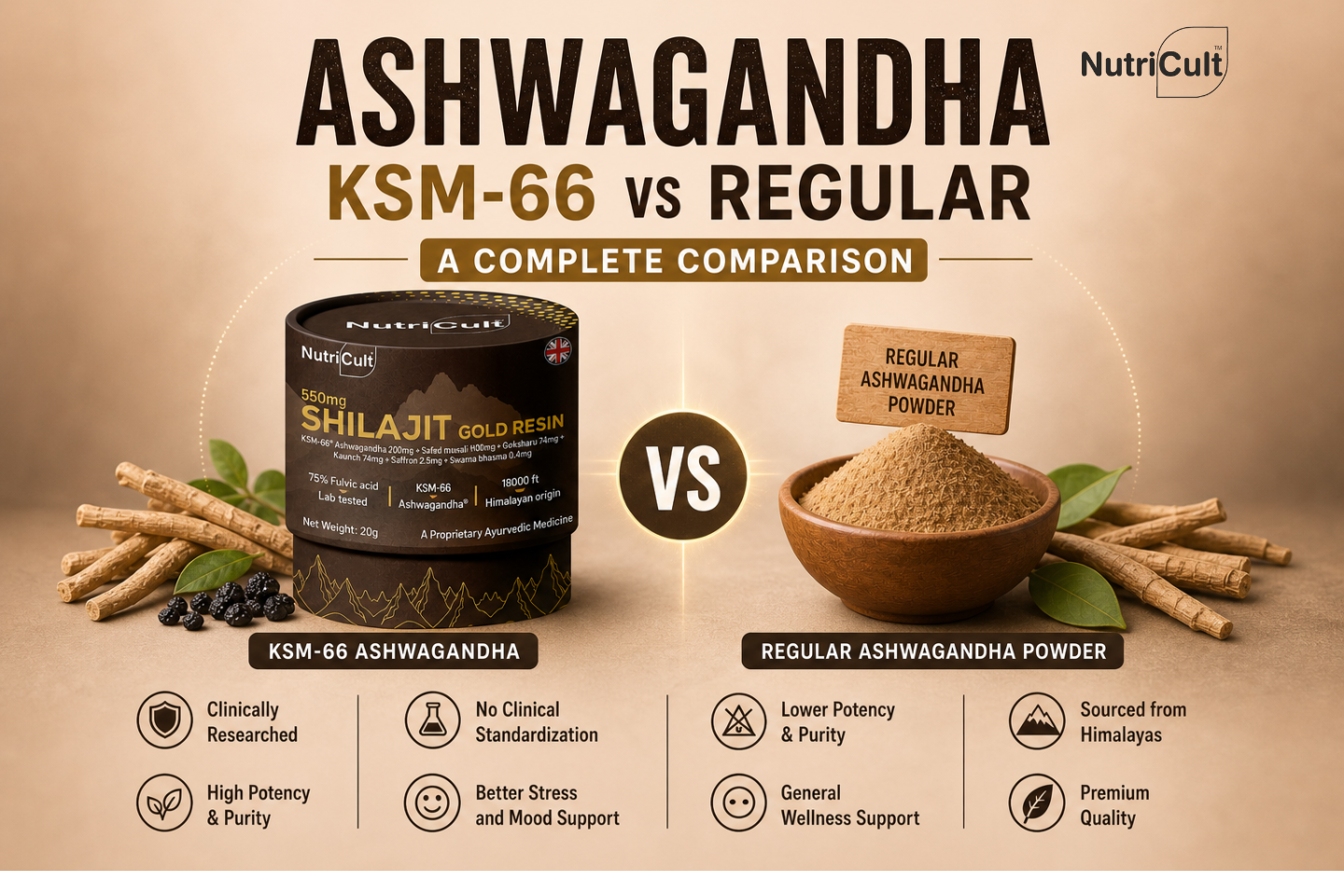
What Makes KSM-66 Different from Standard Ashwagandha?
Ashwagandha (Withania somnifera) contains multiple active compounds, but the withanolides — steroidal lactones found concentrated in the root — are responsible for its most clinically validated effects: cortisol reduction, testosterone support, muscle strength gains, thyroid function normalisation, and cognitive improvement. KSM-66 is produced using a proprietary water and milk extraction process applied exclusively to the root — the plant part with the highest withanolide concentration. The process achieves 5% withanolide standardisation, meaning every gram of KSM-66 contains exactly 50mg of active withanolides regardless of which production batch it comes from. Standard ashwagandha powder mixes root with leaf and stem material, diluting withanolide concentration to typically 0.5 to 2%, and potency varies significantly between batches.
The Clinical Evidence for KSM-66 — Summary of Key Trials
The published clinical trial database for KSM-66 is extensive and consistent. Key findings: A double-blind, placebo-controlled study in chronically stressed adults found serum cortisol reduction of 27.9% and significant improvements in all stress and anxiety questionnaire scores after 60 days of 300 mg twice daily. A study in healthy athletic adults demonstrated significant increases in VO2max over 8 and 12 weeks versus placebo. A randomised trial found KSM-66 significantly improved testosterone levels, sperm quality, and LH levels in men with fertility challenges. A 2025 safety assessment published in Phytotherapy Research confirmed 600 mg/day for 12 months was 'well tolerated without any changes in haematological, hepatic, or thyroid parameters.' New clinical trials (NCT07215455) are currently evaluating KSM-66 for weight and stress management in overweight adults.
Root-Only Extract vs Whole Plant Powder — Why It Matters
Ashwagandha leaves contain significant concentrations of Withaferin A — a compound with potential cytotoxic effects at high doses. While small amounts are unlikely to be harmful, standardised root-only extracts like KSM-66 avoid this entirely by using only the root, which has the safest and most therapeutic phytochemical profile. When a supplement lists 'ashwagandha extract' without specifying KSM-66 or Sensoril (another root extract), it may be a leaf-containing blend. Check labels for the percentage of withanolides — below 2% indicates a whole-plant or low-potency preparation.
Optimal Dosage and Protocol for KSM-66 — How It Is Used in Nutricult Shilajit Gold
Clinical trials use KSM-66 at doses of 300 to 600 mg daily, standardised to 5% withanolides. Nutricult Shilajit Gold Resin incorporates KSM-66 at a clinically relevant dose alongside purified shilajit resin. This combination addresses two complementary adaptogenic mechanisms: shilajit's fulvic acid for cellular energy and mineral support, KSM-66 for HPA axis modulation and cortisol management. The combination is particularly effective for individuals experiencing both physical fatigue and psychological stress simultaneously — the most common dual complaint in urban India.
FAQ
Q: What is the minimum dose of KSM-66 that shows clinical effects?
A: Clinical trials use 300 to 600 mg of KSM-66 daily. At 300 mg twice daily (600 mg total), studies show 27.9% cortisol reduction. At 300 mg once daily, strength and endurance benefits are documented. Below 200 mg of KSM-66 daily, effects in clinical studies are inconsistent.
Q: Does KSM-66 ashwagandha affect thyroid function?
A: Some clinical data shows KSM-66 may improve thyroid function in hypothyroid individuals — specifically normalising T3, T4, and TSH levels. This means individuals with thyroid conditions should monitor thyroid function when starting KSM-66 supplementation, as medication doses may need adjustment.
Q: Can KSM-66 be taken indefinitely?
A: A 2025 safety study confirmed 12 months of 600 mg daily KSM-66 was well-tolerated. For ongoing stress management and adaptogenic support, long-term daily use appears safe. Some practitioners recommend cycling — 8 to 12 weeks on, 2 to 4 weeks off — though this is traditional practice rather than clinical requirement.
Q: Is KSM-66 in Nutricult Shilajit Gold the same as standalone KSM-66 capsules?
A: Nutricult Shilajit Gold contains KSM-66 at a clinically relevant dose combined with purified shilajit resin, Gokshura, Swarna Bhasma, and Saffron. The KSM-66 is the same patented extract — combining it with shilajit addresses both adaptogenic and mitochondrial energy pathways simultaneously.


