


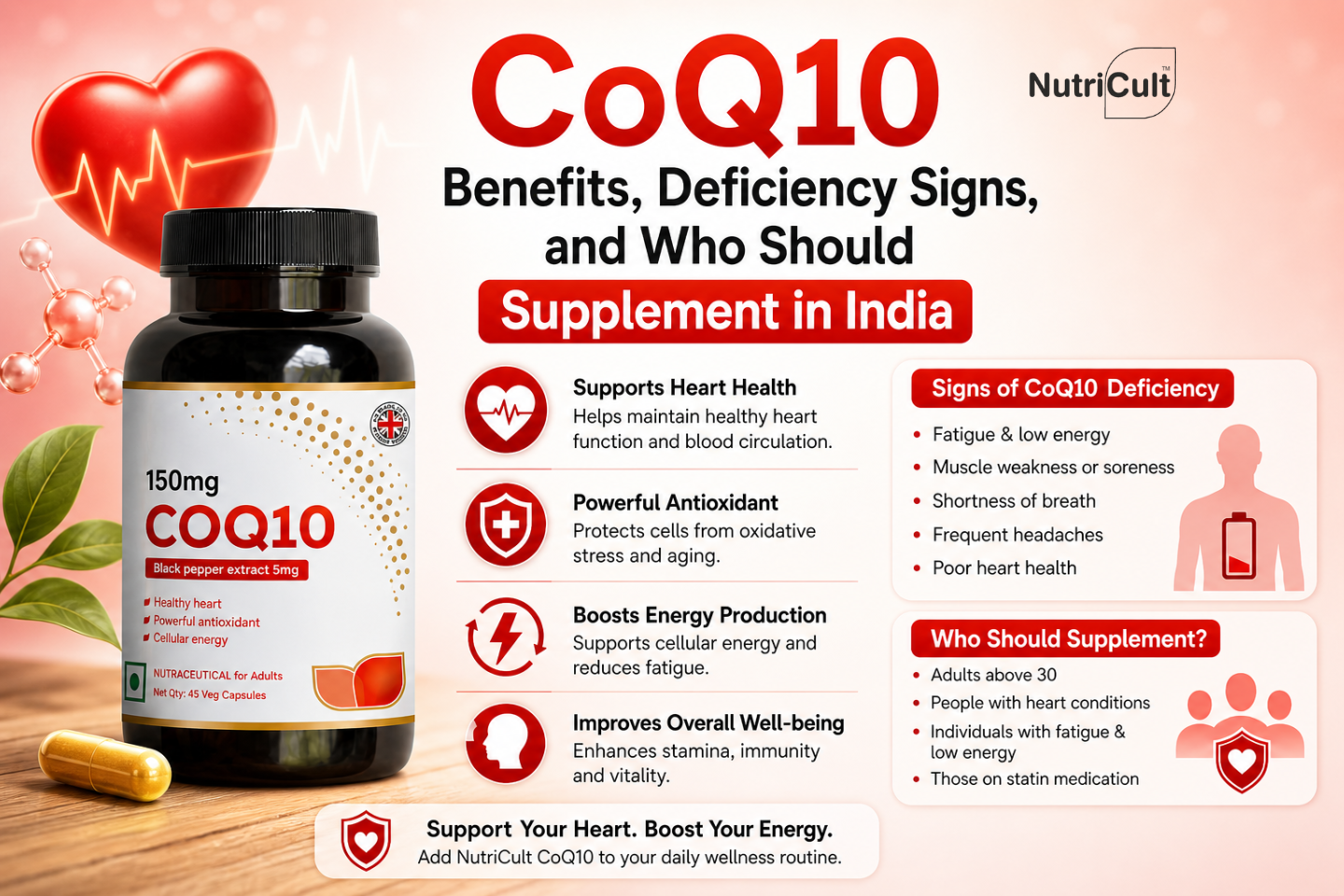
What Is CoQ10 and What Does It Do?
CoQ10, also called ubiquinone (in its oxidised form) or ubiquinol (in its reduced, active form), was first identified by Frederick Crane of Wisconsin in 1957. It is ubiquitous — found in literally every cell membrane and mitochondrion in the human body. Its name derives from this ubiquity.
Its core function is in the mitochondrial electron transport chain — the metabolic process that converts the food you eat into ATP, the energy currency every cell burns to perform its functions. CoQ10 shuttles electrons between the protein complexes of the chain, making it the critical link in cellular energy production. Without adequate CoQ10, this chain slows, ATP output drops, and cells — particularly those in high-demand organs like the heart — begin to function suboptimally.
Its secondary function is as a lipid-soluble antioxidant. Embedded in cell membranes, CoQ10 quenches free radicals that would otherwise oxidise membrane lipids — a process that drives cellular ageing, DNA damage, and inflammatory disease progression.
CoQ10 and Heart Health — The Clinical Evidence
The heart is the most metabolically demanding organ in the body, beating over 100,000 times per day and requiring a continuous ATP supply. It has the highest CoQ10 concentration of any tissue — and the most to lose when CoQ10 declines.
The Q-SYMBIO trial — a randomised, double-blind, placebo-controlled study tracking 420 heart failure patients for two years — found that patients receiving 300 mg of CoQ10 daily experienced a 43% reduction in major cardiovascular events and a 42% reduction in cardiovascular mortality compared to placebo. This is one of the most compelling clinical findings in the supplement literature, and its significance for India's high cardiovascular disease burden is substantial.
Beyond heart failure, meta-analyses examining CoQ10 supplementation in hypertensive patients show a consistent mean reduction of approximately 11 mmHg in systolic blood pressure. The mechanism is improved endothelial function and vascular smooth muscle relaxation — both of which are mediated by CoQ10's antioxidant activity in blood vessel walls.
Who Is CoQ10 Deficient in India?
|
Population Group |
Reason for Deficiency |
Supplementation Priority |
|
Adults over 35 |
Endogenous CoQ10 synthesis declines ~1% per year after age 20 |
High — preventive maintenance |
|
Statin users |
Statins block the mevalonate pathway, reducing CoQ10 by 40% |
Very high — therapeutic restoration |
|
Heart failure patients |
Tissue CoQ10 levels are measurably reduced in cardiac muscle |
Very high — under cardiologist supervision |
|
People with diabetes |
Oxidative stress from metabolic dysfunction depletes CoQ10 faster |
High |
|
Vegetarians/vegans |
CoQ10 is found primarily in animal products (organ meats, fish) |
Moderate-high — dietary gap |
|
Athletes in intense training |
High mitochondrial demand accelerates CoQ10 turnover |
Moderate |
|
People with thyroid disorders |
Hypothyroidism reduces CoQ10 synthesis enzymes |
Moderate |
CoQ10 and Statin Medications — A Critical Connection
Statins — atorvastatin, rosuvastatin, simvastatin — are among the most prescribed medications in India for cholesterol management. They work by blocking the enzyme HMG-CoA reductase, which is the rate-limiting step in cholesterol synthesis. The problem is that this same enzyme also produces CoQ10. Block HMG-CoA reductase and you block both cholesterol and CoQ10 production simultaneously.
Clinical research confirms that statins reduce plasma CoQ10 levels by an average of 40% within weeks of starting therapy. This CoQ10 depletion is one of the primary mechanisms behind statin-associated muscle symptoms (SAMS) — the fatigue, myalgia, and weakness that affect 10 to 25% of statin users and is the leading cause of statin discontinuation in clinical practice.
For India's large statin-using population, CoQ10 supplementation addresses this depletion directly. A 2025 comprehensive review in Antioxidants examined dozens of human studies and concluded that CoQ10 supplementation 'may help restore balance' in statin users, with potential benefits for muscle symptoms, energy levels, and cardiovascular markers.
Why Vegetarian CoQ10 Capsules Matter in India
India's supplement market overwhelmingly offers CoQ10 in softgel (gelatin-based) capsules. Gelatin is an animal-derived ingredient that excludes the estimated 38 to 40% of India's adult population who follow vegetarian diets, and the substantially larger proportion who follow specific dietary practices excluding certain animal products.
Nutricult CoQ10 uses HPMC (hydroxypropyl methylcellulose) — a plant-derived capsule material — with a bioavailability-optimised formulation. The fat-soluble nature of CoQ10 requires a carrier system even in vegetarian formats. Nutricult's HPMC capsule delivers CoQ10 in a carrier system that achieves absorption comparable to oil-based softgels — making it the only genuinely plant-based CoQ10 supplement in its price tier in India.
FAQ
Q: Should CoQ10 be taken with food?
A: Yes — this is critical. CoQ10 is fat-soluble and absorbs 30 to 40% better when taken with a meal containing dietary fat. Taking it on an empty stomach significantly reduces absorption. Ideally, take it with your largest meal of the day, which typically contains the most fat.
Q: What is the difference between ubiquinol and ubiquinone CoQ10?
A: Ubiquinone is the oxidised form; ubiquinol is the reduced (active) form. Marketing often claims ubiquinol is superior, but clinical evidence is mixed. The body readily converts ubiquinone to ubiquinol in cells. For most healthy adults, ubiquinone at the correct dose produces equivalent outcomes to ubiquinol at a much lower cost.
Q: How long does CoQ10 take to show results?
A: Energy and exercise recovery improvements are typically noticed within 4 to 8 weeks. Cardiovascular markers — blood pressure, ejection fraction — require 12 weeks of consistent supplementation to show changes in clinical measurements. Sustained daily use is more important than the initial dose.
Q: Can I take CoQ10 with Shilajit?
A: Yes — this combination is synergistic. Shilajit's fulvic acid has been shown in laboratory research to stabilise CoQ10 in its active ubiquinol form within the mitochondrial membrane, enhancing its electron transport function. This is the scientific rationale behind Nutricult's Energy and Performance Kit.
 Buy Nutricult CoQ10 Vegetarian Capsules for Heart Health and Energy


