


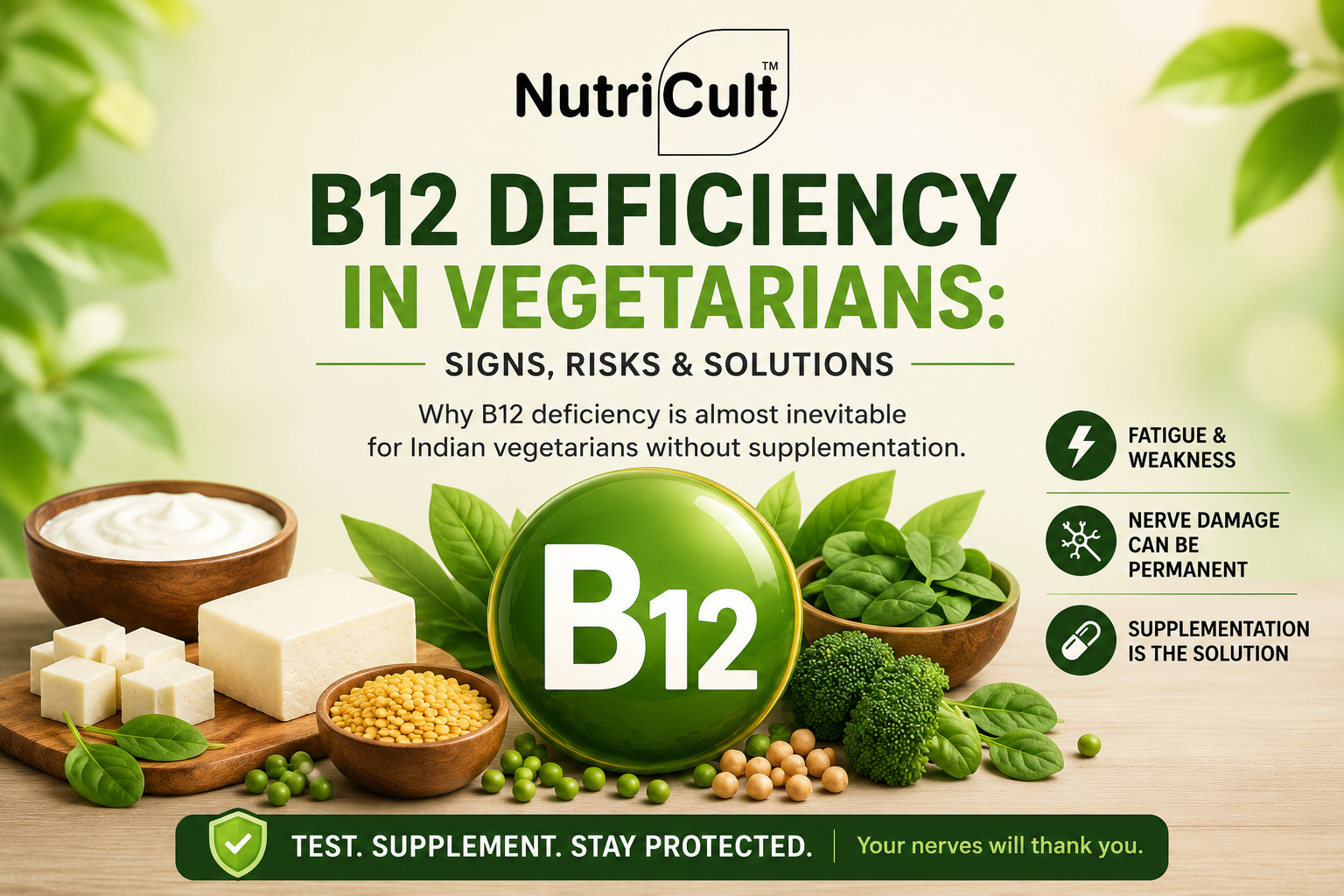
Why B12 Deficiency Is Structural For Indian Vegetarians
B12 exists almost exclusively in animal-sourced foods. Plant foods do not naturally contain it. For over 500 million vegetarians in India, this creates a gap that no amount of dal, paneer, or leafy greens can close. Deficiency builds over years before symptoms appear.
The Two Critical Functions of B12
B12 is essential for red blood cell formation and for maintaining the myelin sheath that insulates nerve fibres. Myelin damage causes neurological symptoms that can be irreversible if B12 deficiency is prolonged.
Signs of B12 Deficiency
Early Signs
• Persistent fatigue and weakness
• Pins and needles in hands and feet
• Pale skin tone; sore or inflamed tongue
• Recurring mouth ulcers
Advanced Signs
• Memory problems and difficulty concentrating
• Mood changes and depression
• Balance problems and unsteady gait
Normal B12 Levels
|
Serum B12 |
Interpretation |
Action |
|
Below 200 pg/mL |
Deficient |
Supplement immediately |
|
200 to 300 pg/mL |
Borderline |
Supplement if vegetarian or symptomatic |
|
300 to 900 pg/mL |
Sufficient |
Maintain |
|
Above 900 pg/mL |
High |
Investigate if not supplementing |
The Spirulina Myth
Spirulina contains B12 analogues that compete with real B12 for absorption. A vegetarian relying on spirulina for B12 may not just fail to correct deficiency but worsen it. Only fortified foods and supplements provide reliable B12.
FAQ
Can curd and paneer provide enough B12?
100g of paneer provides approximately 0.8 mcg B12 against a daily requirement of 2.4 mcg. Meeting requirements through dairy alone requires very large, consistent daily portions. Supplementation provides reliable insurance.
How long to recover from B12 deficiency?
Blood parameters normalize within four to eight weeks. Neurological symptoms take three to six months. Earlier correction means more complete recovery.


